A Jeep campaign duck is specified from the carton backwards: pack, date, print and the test file that travels with it. Colour is the last decision, not the first, because the pack and the date constrain it.
The event date and the carton are fixed before the colour is chosen, and that order is the brief.
In short: rubber ducks for jeeps are a specification before they are a colour. Six lines carry the whole campaign: the compound, the hardness, the colour reference, the print method, the pack format and the test file. A brief that names those six can be checked at the sample and again at the carton, and a brief that names only a colour cannot be checked at all.
What a Jeep campaign duck has to survive
A campaign duck lives a harder life than a shelf duck. It is handled at a meet, dropped in a cupholder, carried in a bag, left on a dashboard and sometimes taken home by a child. Each of those is a different requirement, and a duck that satisfies one of them can still fail another.
The event side is about handling and pack. A duck that arrives loose in a carton will be counted by hand at the worst possible moment, and a duck that arrives bagged can be handed out without touching it. The owner side is about the vehicle and the seasons, which is why the sun and the heat belong in the brief even when the event is indoors. The jeep duck note covers what the category is bought for, and the club note covers the economics of a club order.
What that means for sourcing is that the campaign should be specified as a product rather than as a print job. A product has a material, a colour, a print, a pack and a document set. A print job has a logo and a quantity, and it is the shorter brief that produces the longer argument after delivery.
Material is a spec, not a colour
| Spec line | What to write on the sheet | Why it matters on a campaign |
|---|---|---|
| Compound | The family and the plasticiser route | Decides the feel, the weight and the compliance file |
| Hardness | A durometer reading with a tolerance band | Decides how the body holds shape and how the print sits |
| Colour | A physical reference, not a screen value | Decides whether the club colour is matched |
| The method, the placement and the number of passes | Decides how the logo reads at arm's length | |
| Pack | Bag, card, box or loose, with a count in each pack | Decides what reaches the event intact |
| Test file | Which report covers which market and which age band | Decides who can sell it, and where |
The compound line is the one buyers skip. It decides the plasticiser route, which in turn decides whether the file has to address a phthalate limit, because a children's toy containing specified phthalates is prohibited in the United States (16 CFR 1307.3). A campaign duck is usually a children's toy by default, since it will reach a child, so the route belongs on the sheet before the sample is approved.
Hardness is the second line buyers skip. Two ducks can look identical and feel completely different, and the difference shows up in how the body holds a print and how it behaves in a bag. The hardness note covers the reading and what it changes.
Print method decides how the logo reads
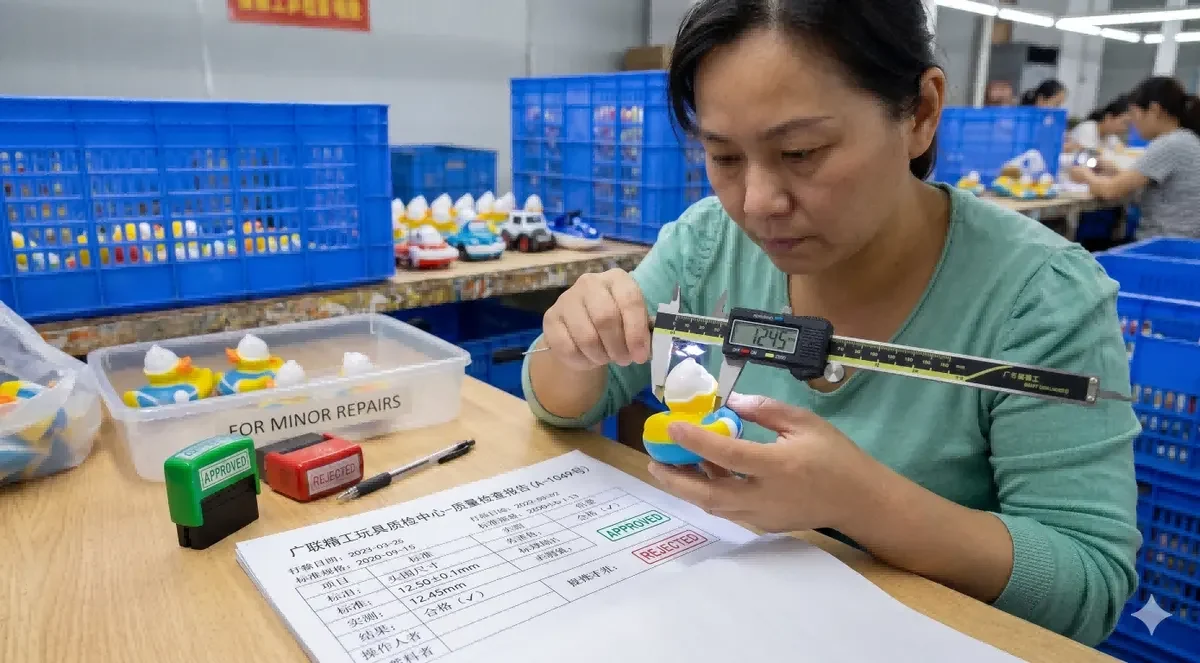
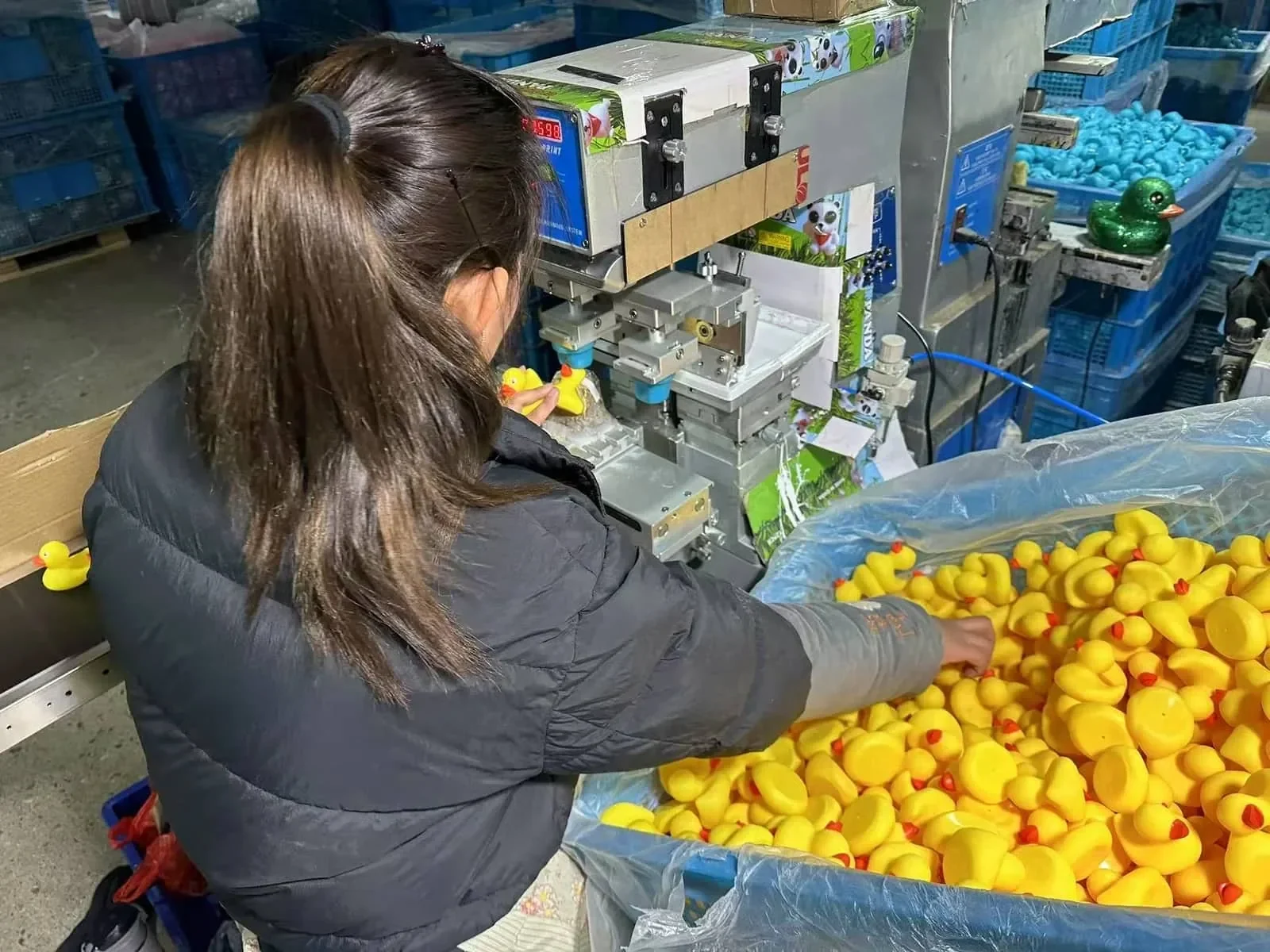
The same logo can be sharp, soft or patchy depending on the method, and the method has to be chosen against the surface rather than against a preference. A pad print suits a small mark on a curved chest. A UV print carries more colour and finer detail. A transfer can cover a larger area, with a different feel under the thumb.
Placement is part of the method decision. A mark on the chest reads best because the surface is closest to flat, a mark on the flank wraps and narrows, and a mark on the head is the hardest to keep straight. If the campaign needs a mark, a number and a club name, the three may need two methods and two placements rather than one crowded pass.
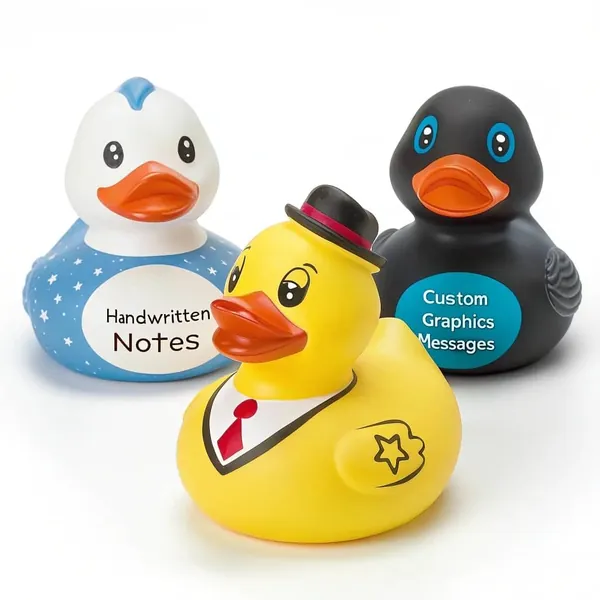
The proof is what settles it. A four view proof shows the mark where it will actually sit, front, side, back and top, and a cured sample shows whether the edge holds. That sample is also the only way to see whether the ink has changed the colour of the body underneath it. The print method note compares the options, and the tag note covers the message when it does not go on the duck.
The theme is a look, not a licence
A Jeep campaign usually borrows a visual language: a grille, a badge shape, a colour, a wave. Most of that is available as a theme, and none of it is available as a right. A theme is a look that a designer can work in. A licence is permission to use somebody's mark, and the two are not the same document.
The line that matters is confusion. Using a mark, a name or a device in commerce in a way that is likely to cause confusion about the source of the goods is actionable (15 U.S.C. 1125), and a duck that carries a vehicle badge is a duck that is trading on somebody else's identity. A themed duck that uses a colour and a shape without the badge is a different product, and it is the one a campaign can order without a licence conversation.
That distinction has a practical benefit as well as a legal one. A themed design can be repeated next season without renegotiating permission, and it can be sold in more than one market. The personalisation note covers the wording that a club can add in its own right.
The sample chain, and where a bulk order drifts
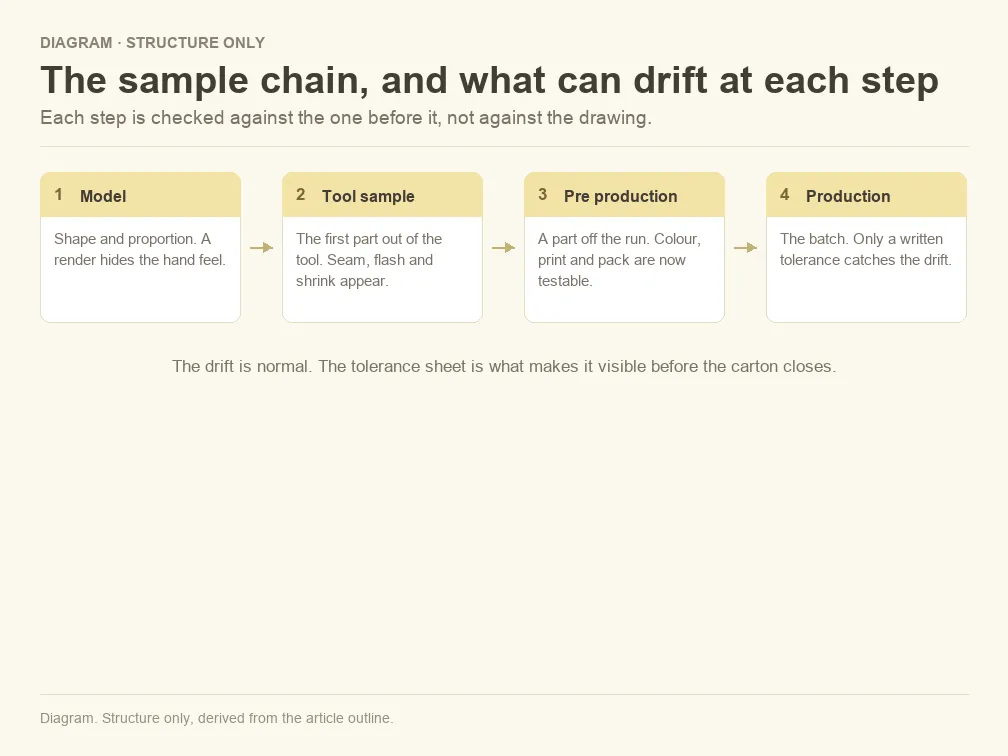
A sample is a photograph of a process rather than the process itself, and the drift happens between the steps. The chain has four of them: the model, the tool sample, the pre production sample and the production batch. Each one is judged against the one before it, which is why the written tolerance matters more than the sample photograph that tends to get saved.
The model settles the shape and the proportion. The tool sample is the first part out of the tool, and it is where the seam, the flash and the shrink appear. The pre production sample comes off the run, so it is the first point at which the colour, the print and the pack can all be judged together. The production batch is where the last drift happens, and it is the one nobody sees until the carton is open.
Tolerances have to be numbers. A body colour needs a reference and a permitted deviation, a print needs a position and a size, and a carton needs a count and a weight. A sheet that says close to the sample is a sheet that guarantees an argument, because close is not a value. The approval note covers the photo and physical record, and the consistency note covers what a production run has to reproduce.
Packaging is part of the drop
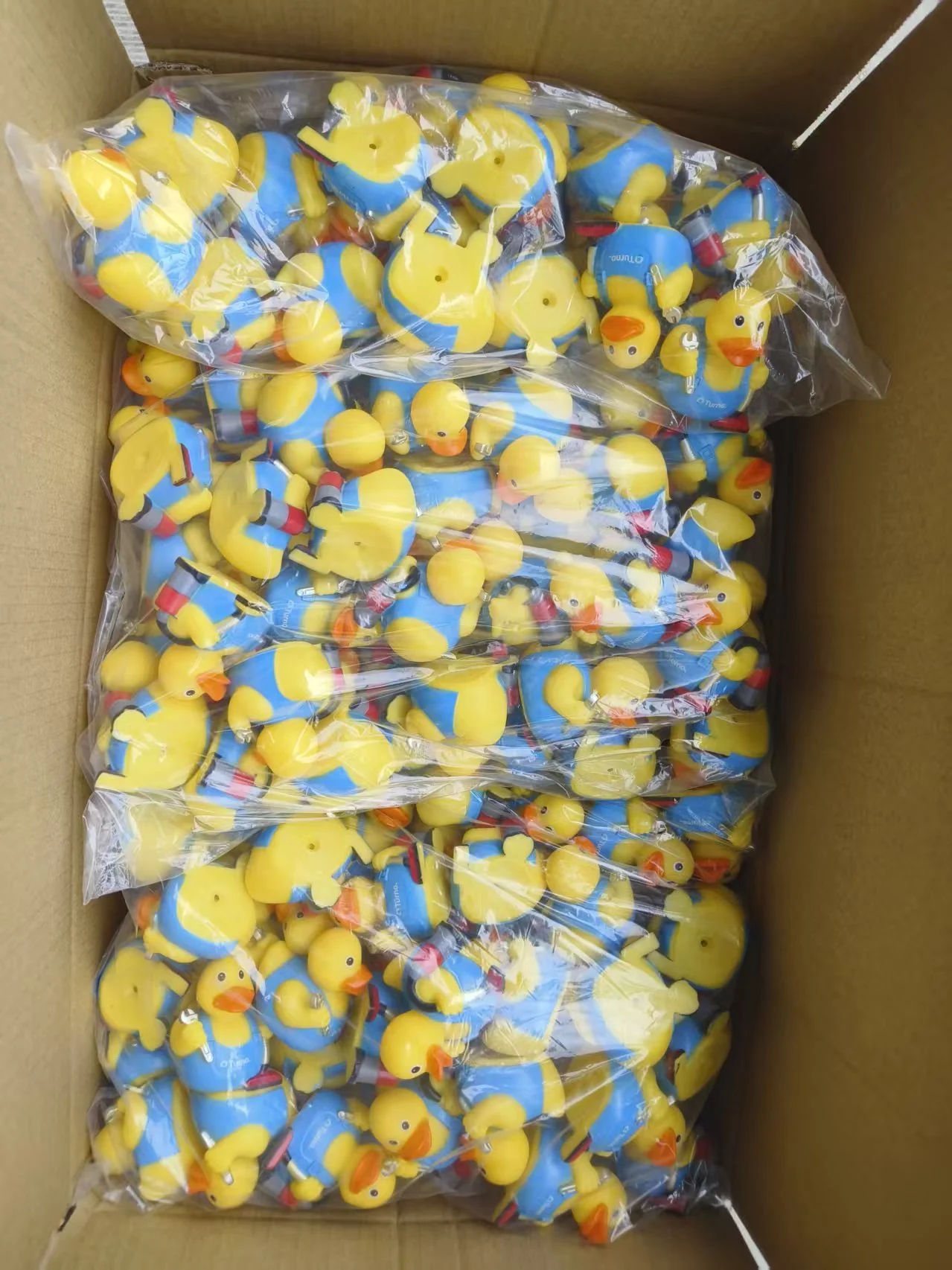
A carton is the last thing the factory touches and the first thing the event sees. It decides whether the ducks arrive counted, protected and ready to hand over, and it is the least expensive part of the campaign to get wrong and the most visible to fix.
The pack format should be chosen against the handover. Loose ducks suit a table where a volunteer fills bags, bagged ducks suit a queue, and a carded duck suits a sponsor who wants the message to travel with the duck. Each format changes the carton count, the weight and the way the carton is marked, which is why the pack belongs on the same sheet as the print rather than on a later email.
Transit is the other half. A parcel shipment is handled more times than a pallet, and a carton that is fine on a pallet can arrive crushed in a parcel network. The industry body for transit testing publishes procedures for exactly this comparison (ISTA test procedures), and a campaign that ships in parcels should ask which procedure the carton was designed against.
The test file travels with the campaign
The file is the part of the order that nobody enjoys and everybody needs. It has to say which report covers the product, which age band it was assessed for, which market it was written for and who holds the original. Without it, a campaign can be delivered and still not be sellable in the market it was made for.
The ownership question is the one that surprises buyers. For a children's product in the United States, the certificate of conformity is issued by the importer or the domestic manufacturer, not by the factory that moulded the part (16 CFR Part 1110), so a club that imports the carton is the party that signs. That signature relies on the test report underneath it, and the report is only useful if it names the product, the age band and the market.
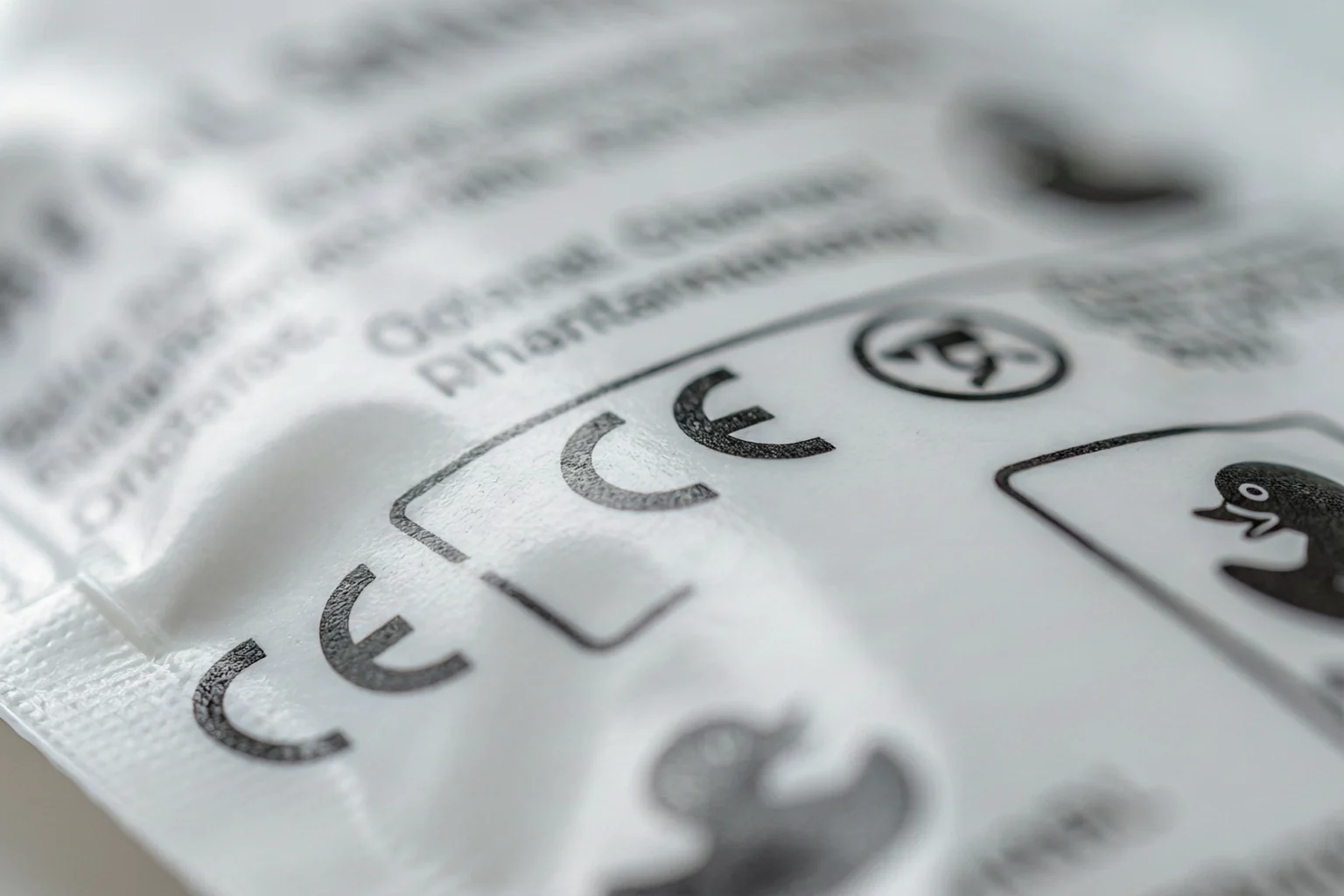
The label is the visible end of the same file. A CE mark and an age symbol are not decoration, and they have to match the report rather than the artwork. The toy label note covers what goes on the label and where, and the batch file should hold a photograph of it.
The checklist before the first carton
- Which compound and which plasticiser route are on the sheet, and does the age band accept them?
- Which hardness reading and which colour reference will the sample be judged against?
- Which print method and placement carry the mark, the number and the club name?
- Which pack format does the handover need, and which carton count follows from it?
- Which report covers which market, and who signs the certificate for the carton?
Five answers make a one page brief that a factory can work from, a sample can be judged against and a carton can be checked against. The list is short on purpose, because the failures that matter are the ones that were never written down rather than the ones that were written badly.
Final Note
My preference is a short sheet with numbers in it, agreed before the first sample and kept with the carton. A campaign is a deadline, and a deadline makes people skip the middle of the process, which is exactly where the drift lives.
The duck is a simple product, and that is the trap. It looks easy enough to order from a photograph, and it is complicated enough to arrive wrong. The buyers who avoid that are the ones who wrote the six lines down and then checked the sample against them rather than against the picture.
Frequently Asked Questions
Where can brands get ducks for a Jeep campaign?
From a factory that can show the compound line, a print sample and a test file for the market the campaign sells in. The supplier's location matters less than those three, because a duck without a file is a duck that cannot be sold in some markets whatever the factory looks like.
What size duck works best for Jeep ducking?
The size follows the hand and the cupholder rather than the logo. A duck that fits a palm is easy to hand over and easy to place, and one that is too large becomes a display piece rather than a giveaway. The size also changes the carton count, so it belongs in the first conversation.
How do I stop the print peeling on a dashboard?
Cure and adhesion first, placement second. An ink that has not cured fully will lift at the edge before it fades, and a mark on a curved flank is more exposed than one on the chest. If the duck will live on a dashboard, say so in the brief rather than in the complaint.
Do promotional ducks need safety testing?
When the duck can reach a child, which covers most campaigns. The test follows the age band and the market, and the certificate is issued by the party that places the product on the market. A campaign that has not decided the age band cannot decide the test.
Key takeaways
- What a Jeep campaign duck has to survive: event handling and vehicle life are two different requirements.
- Material is a spec, not a colour: the compound and the hardness decide the feel, the print and the file.
- Print method decides how the logo reads: the surface chooses the method, and a four view proof settles it.
- The theme is a look, not a licence: a colour and a shape can be repeated without permission, a badge cannot.
- The sample chain, and where a bulk order drifts: four steps, each judged against the one before it.