Duck fifty, not duck one, shows whether a sample approval became a production standard. Duck one is the object everyone has seen; the fiftieth is the one that says what the line actually does.
That distinction is the whole subject. A sample bag is a promise; a carton is the delivery of that promise, and the gap between them is almost never a single dramatic failure. It is a set of small moves that nobody wrote down.
In short: consistency is decided by what both sides still hold. Keep a sealed golden sample, approve a first article from the production tool before the batch is released, and put the acceptance lines in the order rather than in an email. A batch can only be checked against an object, so the object has to survive the meeting, the shipment and the year.
The gap appears in the carton, not the sample bag

A sample bag holds one duck, chosen or made to be shown. A carton holds the average of a run, and averages are where variation lives. The two objects are compared by eye, at arm's length, in different lights, often by different people, which is a comparison with four variables and no control.
The useful move is to stop comparing a duck with a duck and start comparing a duck with a record. A record names the tool, the compound, the colour reference, the print plate, the pack and the date, and then the carton can be checked line by line rather than by feel.
Once that exists, the conversation changes from "this looks different" to "line four is outside the reference", which is a conversation a factory can act on.
Where the drift actually comes from
| Source of drift | What moves | How you see it | The control |
|---|---|---|---|
| Tool and cavity | Seam weight, flash, ejection marks | A heavier line or a new mark | Same tool, first article check |
| Compound batch | Feel, colour base, smell | A body that squeezes differently | Compound lot recorded against the order |
| Pigment and masterbatch | Shade, especially in strong colours | Two ducks side by side look different | Physical reference and a stated light |
| Print plate and ink | Line weight, coverage, edge | A mark that reads heavier or softer | Plate retained, proof signed |
| Operator and station | Placement, trimming, packing | Small position differences in a carton | Written placement measured in inches |
| Storage and transport | Surface, distortion, smell | A duck that arrives different from the one packed | Pack and storage specified |
Read the table by column three. Every source of drift has a visible tell, and none of them needs a laboratory to detect. What they need is somebody comparing the carton with a reference rather than with an impression.
The golden sample is the instrument

A golden sample is the duck that both sides agree is correct, sealed, labelled and kept. It is not the prettiest duck from the run and it is not the first one off the tool; it is the one that was approved, and its value comes from being held by two parties rather than one.
The seal matters more than the box. A sample that has been handled, squeezed and left on a desk for a month has changed, and comparing a new batch against a changed object produces arguments about the object rather than about the batch. A sealed reference cannot drift.
The second copy is the part buyers skip. If only the factory holds the golden sample, the buyer is comparing from memory, and memory is generous to whichever side wants it to be.
A first shot is not a first article
The first shot from a tool is a machine event. It tells you the tool closes, fills and ejects. The first article is a production event: a part made under the conditions the batch will run in, checked against the golden sample and signed before the rest of the batch is released.
Those are different objects and they are commonly confused, which is how a batch gets released on the strength of a part that was made slowly, by hand, with extra care. The prototype note covers the stage before the tool; the first article is the stage after it.
The hold point is the practical expression of the difference. The batch does not proceed until the first article is signed, and the signature names who checked it and against what.
Five checks a first article has to pass
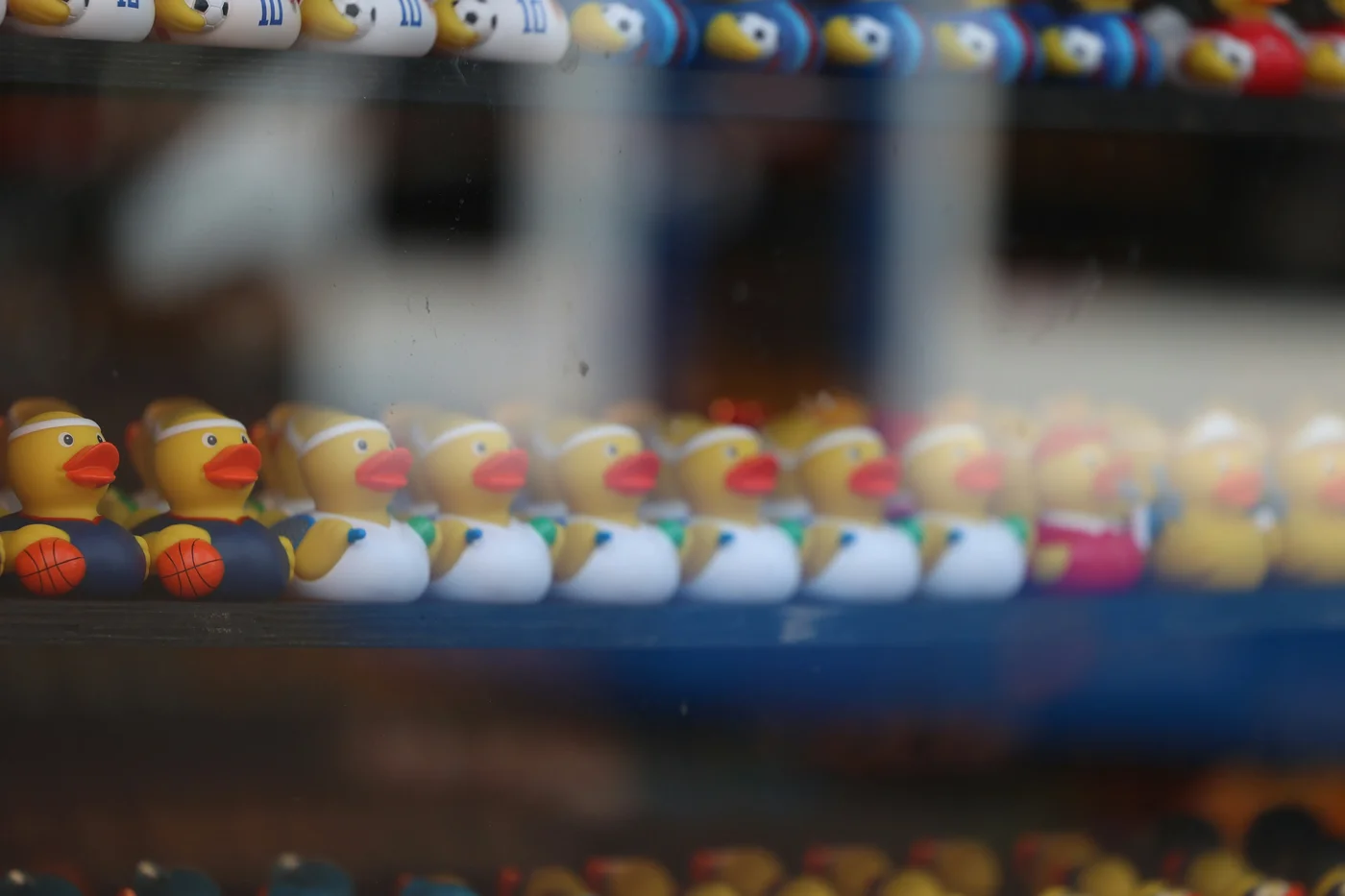
The first check is the body against the reference: shape, wall feel, seam and base. The second is colour, against the physical reference and under a stated light rather than under whatever lamp is nearest. The third is the print, at the position written in inches and at the size the customer will see. The fourth is the assembly, if there is one, including any insert, squeaker or hat. The fifth is the pack, because a duck and its pack are one product at the point of sale.
Five checks, one duck, one signature. The sample approval note explains why a photograph cannot carry this, and the squeeze and drop tests explain what the physical check is looking for.
Why production conditions move
A batch is made by people in a room over a period of time, and conditions in a room change. A press warms up through the shift, a pigment lot arrives slightly different, a humidity change alters how a print sits, and a new operator stands at a station for the first time. None of those is a fault, and all of them move a part.
What protects the batch is not preventing movement but noticing it. That means a check at the start, a check partway through and a check at the end, each against the same reference, and a record that a second person can read.
The other protection is the compound lot. A body made from a different lot can feel different without looking different, and the wall thickness note and hardness note are the two pages that explain why the hand notices what the eye does not.
Writing acceptance into the file
Acceptance is a written line, not an intention. The line names the reference, the checks, the tolerance and the person who signs, and it sits in the order rather than in a thread. "Matches the approved sample" is not an acceptance line, because it does not say which sample or what happens when it does not match.
The second half is the remedy. A file that says what happens when a carton fails is a file that gets taken seriously, and the remedy is usually a re-check rather than a return. The supplier audit note covers the questions to ask before an order, and the inspection note covers where the checks sit in the process.
What goes in the approval file

A working file has five parts: the sealed golden sample, the specification sheet with the five check lines, the two proofs (body print and pack), the first-article record with its signature, and the pack and carton specification. Two copies of the file, one at each end, and a dated version number.
That file is also what makes a reorder simple. A second order that opens with the file repeats the product; a second order that opens with a memory repeats the argument.
What to settle before the bulk is released
- Is the reference a sealed duck both sides hold, or a photograph?
- Has a first article from the production tool been signed?
- Is the colour checked against a chip under a stated light?
- What exactly happens when a carton does not match the reference?
The mockup checklist covers the stage where the object is still a picture, and the design revision note covers what happens when the reference itself has to change mid-project.
What the rules ask of a batch
A batch is not only a consistency question; it is also a conformity question. In the European Union, toys placed on the market have to meet the essential safety requirements of Directive 2009/48/EC and carry the CE marking, as the European Commission's toy sector page sets out, which is a promise about production and not only about a sample.
In the United States, section 106 of the Consumer Product Safety Improvement Act made ASTM F963 a mandatory consumer product safety standard for toys, as the statute text at Cornell LII records. A duck that matched the sample but drifted on a tested property has not met either frame, which is why the first-article check and the test report have to describe the same object.

Frequently Asked Questions
Why does bulk production differ from the approved sample?
Because a sample is one object chosen or made to be shown, and a batch is an average made over time by people in changing conditions. The differences are usually small and cumulative: a shade, a seam weight, a print position, a pack fit.
What is a golden sample?
The duck both sides agree is correct, sealed, labelled and kept. It is the physical reference a batch is checked against, and it works because it cannot drift, unlike a memory or a photograph.
How is colour checked during a batch?
Against a physical reference, under a stated light, by eye at the distance a customer uses. A screen is not a reference and a photograph is not a record, which is why the chip and the sealed sample both travel with the order.
What terms should the order include?
The reference sample, the five check lines, the tolerance, the first-article hold point, the person who signs and what happens on a fail. Written as lines in the order rather than as good intentions in an email.
Final Note
The habit is to ask which duck the batch will be judged against before asking how the batch is going. If the answer is a sealed object on a shelf in two places, the batch has a chance. If the answer is a photograph in a chat, it does not.
Duck one gets the attention. Duck fifty is the one that decides whether the approval meant anything.
Key takeaways
- The gap appears in the carton, not the sample bag: A sample bag holds one duck, chosen or made to be shown.
- Where the drift actually comes from: Read the table by column three.
- The golden sample is the instrument: A golden sample is the duck that both sides agree is correct, sealed, labelled and kept.
- A first shot is not a first article: The first shot from a tool is a machine event.
- Five checks a first article has to pass: The first check is the body against the reference: shape, wall feel, seam and base.
- Why production conditions move: A batch is made by people in a room over a period of time, and conditions in a room change.
- Writing acceptance into the file: Acceptance is a written line, not an intention.
- What to settle before the bulk is released: The section on "what to settle before the bulk is released" sets out the checks that answer it.