Fragrance belongs in the specification before the duck is discussed, because the route and the dose decide what survives moulding and what a buyer can check on arrival. Which fragrance, at what version, applied by which route, at what dose, and what the piece must still smell like after a season in a warehouse: those are the fields. A picture of a duck and a sentence about something nice is the one instruction a supplier cannot hold a buyer to.
A scent is a fragrance specification rather than a mood, and the dose has to be written down.
In short: a scented duck is a fragrance delivery problem inside a PVC toy. Pick the route first, because the route decides what survives moulding, what wears off in the hand, and how long the smell lasts in a bag. Then get the fragrance house's identity sheet, IFRA statement, allergen declaration and safety data sheet on file, and write down the dose in grams per duck. The toy rules and the age grading come after those, and never instead of them.
Why a scent is a specification, not a decoration
A scent is the only part of a duck that the buyer cannot see, weigh or print, which is exactly why it causes arguments later. Three variables decide whether the delivered carton smells the way the approved unit smelled: the identity of the fragrance, the dose, and the route by which it was put into or onto the duck. Miss any one of the three and the next batch drifts, even when the duck itself is identical.
The drift is not mysterious. A fragrance is a mixture of volatile compounds, and every step the duck passes through either leaves those compounds where they are or moves them somewhere else: into the air during moulding, into the print solvent, into the polyethylene bag, or into the cardboard of the carton. A supplier who treats scented as a yes or no attribute is really promising an outcome they do not control, and a buyer who accepts that promise has nothing to check against.
So write it as a line item. Fragrance name and version, dose in grams per duck, route, and a reference unit that the acceptance check compares against. Everything else in this note follows from those fields, including the material question of whether the body is PVC, TPR or silicone, because each one holds a fragrance differently (the three body materials compared).
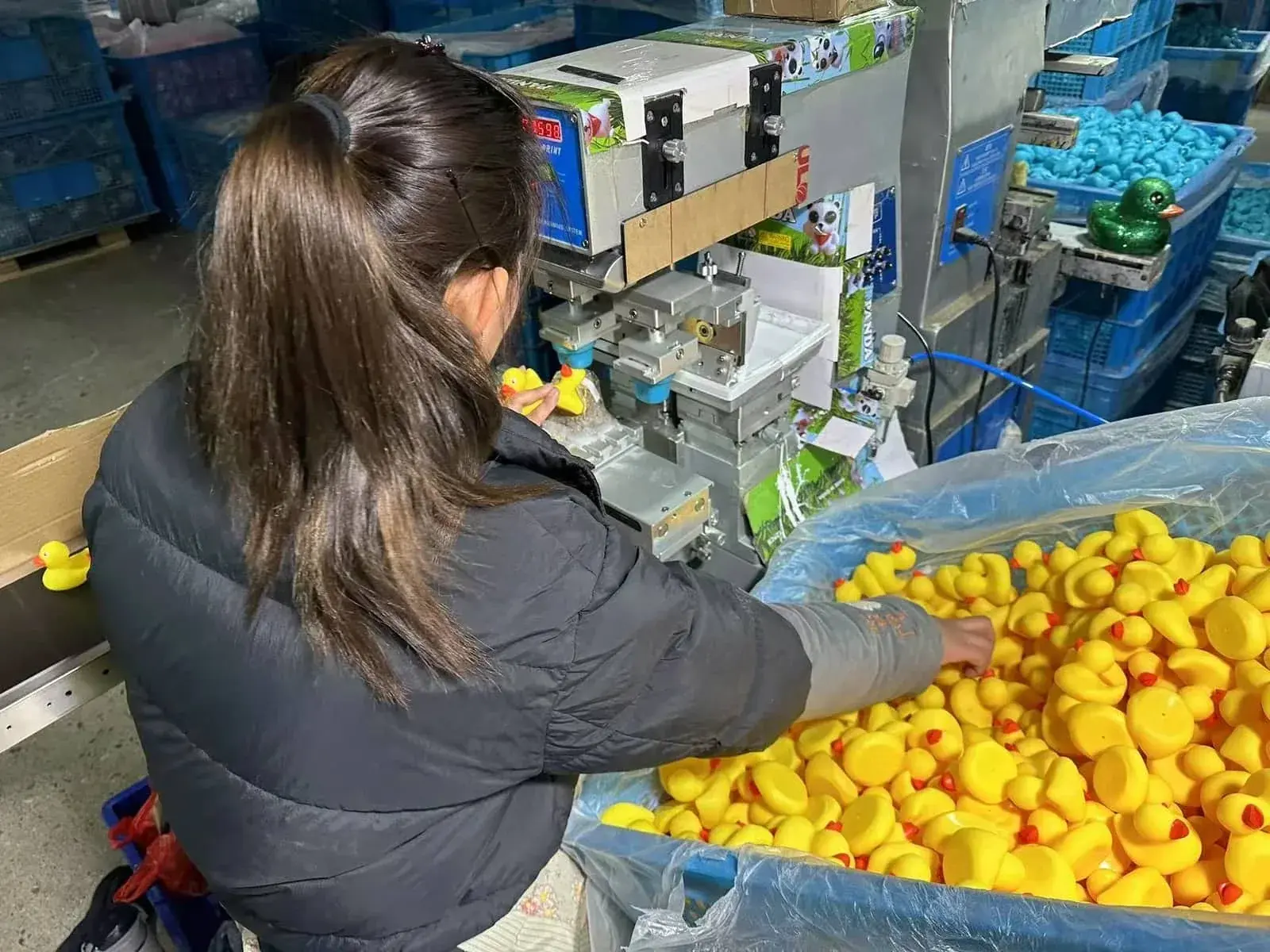
It also helps to walk the route the duck takes after moulding, because every station is a place where the fragrance can move. The print station is the obvious one, since the duck is handled, pressed and dried there, and a scented body that goes through print is not the same object that came out of the mould.
Two routes, and a third that sits between them
The first route puts the fragrance into the PVC compound before the duck is moulded, usually through a masterbatch. It gives the most even result through the wall of the body, but the moulding heat is the enemy: most aroma compounds are volatile enough that a hot barrel drives a useful fraction of them off, and what survives is a flatter version of the fragrance than the one in the concentrate.
The second route applies the fragrance after demoulding, as a dip or a spray, often in the same step as the surface finish. Nothing is heated, so the top notes stay intact, but the fragrance now sits where hands, wipes and print go, and it wears from the outside in. The third route, encapsulation, holds the fragrance in a coating that breaks when the duck is rubbed. It stores better and releases later, at the expense of dosing evenly across a batch.
| Route | Where the fragrance ends up | What the process does to it | What the acceptance check looks like |
|---|---|---|---|
| In the compound | Blended through the body wall | Heat drives off the light fractions before the duck exists | Cut a duck and compare the core smell with the reference |
| On the surface | A film on skin, head and print areas | Nothing is heated, but handling and wiping take it off | Rub a fixed number of times, then compare with the reference |
| Encapsulated | Droplets held inside a coating | Stored smell stays closed until the coating is broken | Compare after storage, then again after rubbing |
None of the three is better in the abstract. A duck that will sit sealed in a bag for months before a conference wants the encapsulated route, a duck that is handled the same afternoon wants the surface route, and a duck that has to smell the same through the whole body wants the compound route.

What the fragrance file has to contain
The fragrance house, not the duck supplier, owns most of this file, and a buyer should ask to see it before the first moulded unit exists. Four documents carry the weight. The first is the identity sheet: the fragrance name and version, because vanilla is a family rather than a product, and two versions of the same name can smell different on the same duck.
The second is the IFRA statement, the fragrance industry's own safety standard for the material and its maximum use level. The third is the allergen declaration, which lists the individual fragrance substances in the mixture that have to be declared above the threshold. The fourth is the safety data sheet, which tells the factory how to store and handle the concentrate safely.
A file that stops at the fragrance name is not a file, it is a label. The distance between smells like vanilla and a fragrance a toy can carry is made of those four documents plus a dose figure in grams per piece. Ask for the version date as well, because fragrance houses reformulate, and a reformulation halfway through a programme is the quietest way for a repeat batch to change smell.

The toy rules a fragrance has to pass
A duck is usually a toy, and toys have their own rule on fragrance substances. In the European Union, Directive 2009/48/EC lists in Annex II the fragrance substances that must not be used in toys, with a short list of exceptions allowed only at trace levels below 0.01 per cent by weight (EUR-Lex, Directive 2009/48/EC). That is a toy rule, not a cosmetics rule, and it applies whatever the fragrance house's own standard says. The same Directive places the safety assessment and the technical documentation on the manufacturer and requires CE marking before a toy is placed on the market (European Commission, placing toys on the EU market).
Two practical consequences follow. First, the fragrance house has to be told that the end use is a toy and that the market is the EU, because a fragrance cleared for a candle is not automatically cleared for a child's duck. Second, the allergen declaration and the toy restriction list have to be read together, since a substance can be perfectly legal in a cosmetic and still sit on the toy list. The wider compliance picture, including phthalates and the US route, is covered in the REACH and CPSIA note.
Then comes the age question. If the duck is offered for children under three, the small parts rule applies to any part that can come off in use and abuse testing (16 CFR 1501.4), and a scented cap or a scented tag is a separate part with its own risk. A fragrance decision never overrides the age grading, it has to fit inside it.
How a scent behaves between the factory and the giveaway
Between the last inspection and the moment a duck is handed over, four things move the smell: heat, light, the packaging film and time. Heat accelerates the loss of light fractions, which is why a container parked in the sun for a month can turn a bright fragrance flat. Light does the same work more slowly, and a printed duck adds a solvent step that can carry fragrance out of the surface film.
Polyethylene bags are not inert either. Fragrance compounds migrate into the film, so the bag starts to smell of the duck and the duck starts to smell of less. That is also why a smell that seems too strong on the day of opening can be a storage artefact rather than a dosing error, a point covered in the airing note for new ducks. Wiping makes it worse, because a scented surface film and a cleaning routine pull in opposite directions (cleaning bulk ducks).
That gives the buyer a check that needs patience rather than equipment. Keep one sealed unit from the approved batch, store it the way the delivery will be stored, and smell it at the same interval as the event. Compare it with the reference, not with memory. If the giveaway is three months after delivery, the acceptance check belongs three months after delivery, on a stored unit, not on the day the carton was opened.

The brief that keeps a scented order stable
Six statements turn a scented request into something a factory can hold:
- Which fragrance and which version, by name, house reference and route?
- What dose in grams per duck, and is it a whole body dose or a surface dose?
- Which market and which age band, so that the restriction list and the age grading are settled together?
- How will the smell be checked, on which unit, at what interval, against which reference?
- How will the delivery be stored, and does the packaging protect the fragrance or pull it out?
A brief that answers those six gives the supplier a specification and gives the buyer a defence. The remaining argument, about whether the lavender is too sharp or the vanilla too sweet, becomes a comparison against a reference rather than a matter of taste, and the next carton can be judged against the same reference instead of against the memory of a meeting.
There is one more use case worth naming, because it catches buyers out. Scent is often chosen for a hotel or guest amenity programme where the duck is meant to carry a house signature, and the fragrance then has to survive a wrapped amenity tray as well as a suitcase (the turndown amenity note sets out that brief). A signature scent is a harder promise than a pleasant one, because the guest has the reference in their memory.

Final Note
The scent is the smallest ingredient in a duck and the one most likely to be argued about, because it is the only one the buyer experiences rather than reads. Treating it as a specification, with a route, a dose, a version and a reference unit, turns a subjective argument into a check that either passes or fails.
My preference is the plainer promise: a fragrance that is declared, restricted and dosed, and a smell that is still there at the end of the storage the buyer actually has. That is a smaller claim than long lasting, and a far easier one to keep.
Frequently Asked Questions
Are scented rubber ducks safe for children?
A scented duck is a toy first. The fragrance has to sit inside the toy rules for the market, the allergen declaration has to be on file, and the age grading still decides whether the duck suits the child at all. A fragrance that is legal in a cosmetic is not automatically legal in a toy.
How is the scent put into a rubber duck?
Three routes: blended into the PVC compound before moulding, applied to the surface after moulding, or held in a coating that releases when the duck is rubbed. Each route changes how even the smell is and how long it lasts.
Does a scented duck keep its smell in storage?
Less well than most buyers expect. Heat, light, the bag film and time all move the fragrance, so the useful check is a stored unit smelled at the same interval as the event and compared against the reference.
Can the smell be matched exactly from one batch to the next?
Only if the version is pinned and the dose is written down. Fragrance houses reformulate, and a reformulation quietly changes the smell even when the name on the label stays the same.
Key takeaways
- Why a scent is a specification, not a decoration: identity, dose and route decide the result.
- Two routes, and a third that sits between them: heat, handling and storage pick the route.
- What the fragrance file has to contain: identity, IFRA statement, allergens, safety data sheet.
- The toy rules a fragrance has to pass: the toy fragrance list applies before the fragrance house's own standard.
- How a scent behaves between the factory and the giveaway: store one unit and smell it on the event timeline.