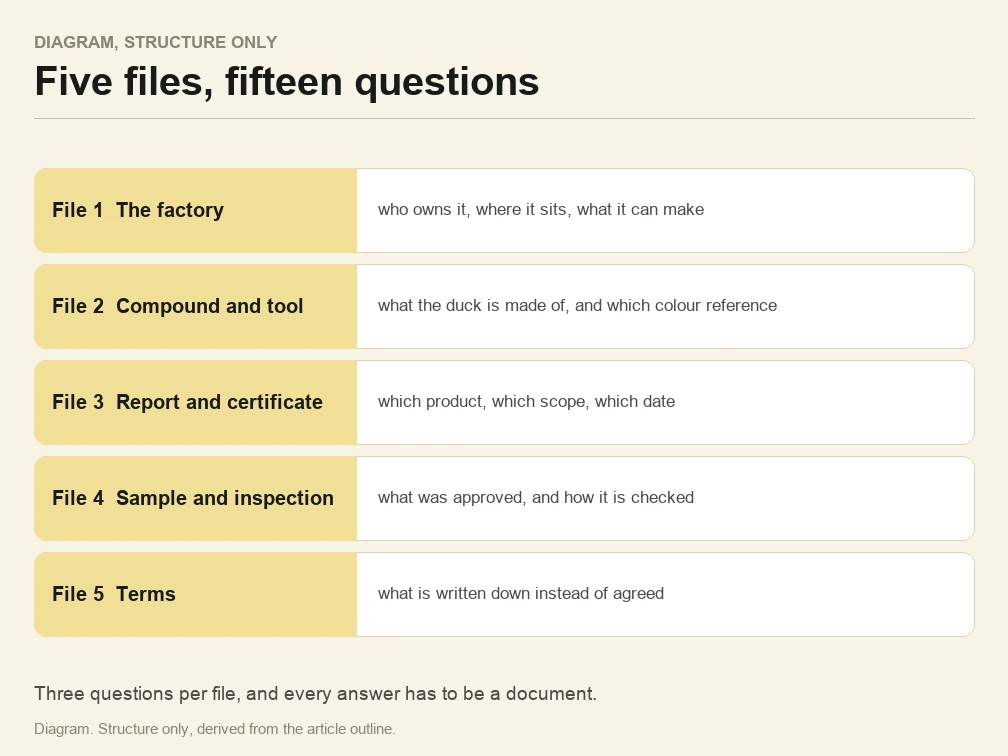
Supplier audits work as a document trail, not as a questionnaire, and each answer has to end in a file with a holder and a date. Fifteen questions are enough when the follow-up sentence is always the same: prove it.
An audit is only worth the afternoon when every answer can be filed with a date and traced back to the duck in the sample bag.
In short: a rubber duck supplier audit is fifteen questions sorted into five files — who the factory is, what the compound and the tool are, which report and certificate cover this duck, what the sample record and inspection plan say, and which terms are written down. An answer you cannot file is a claim, and a claim is exactly what the audit exists to test.
An audit is a document trail, not a questionnaire
A questionnaire can be answered fluently by anyone with a good template, and fluency is the wrong signal. What a buyer needs is a document that could be handed to a laboratory, a broker or a retailer's compliance desk and survive the trip. That test removes most of the ambiguity: either the report names the product, or it does not. Either the carton label matches the run, or it does not.
The practical habit is small. One page and one object per design: the signed standard duck in its bag, and a short file holding the specification with tolerances, the written approval, the artwork and the print proof, and the report that covers the material. That file answers a question about a duck two years after the person who approved it has left the company, which is the point at which most products become unanswerable.
This page is deliberately narrow. It covers the audit file a buyer can build without a plane ticket. A factory visit is a different instrument, and its absence is not a red flag on its own, because most of the file is documents rather than impressions.
File one: who the factory is
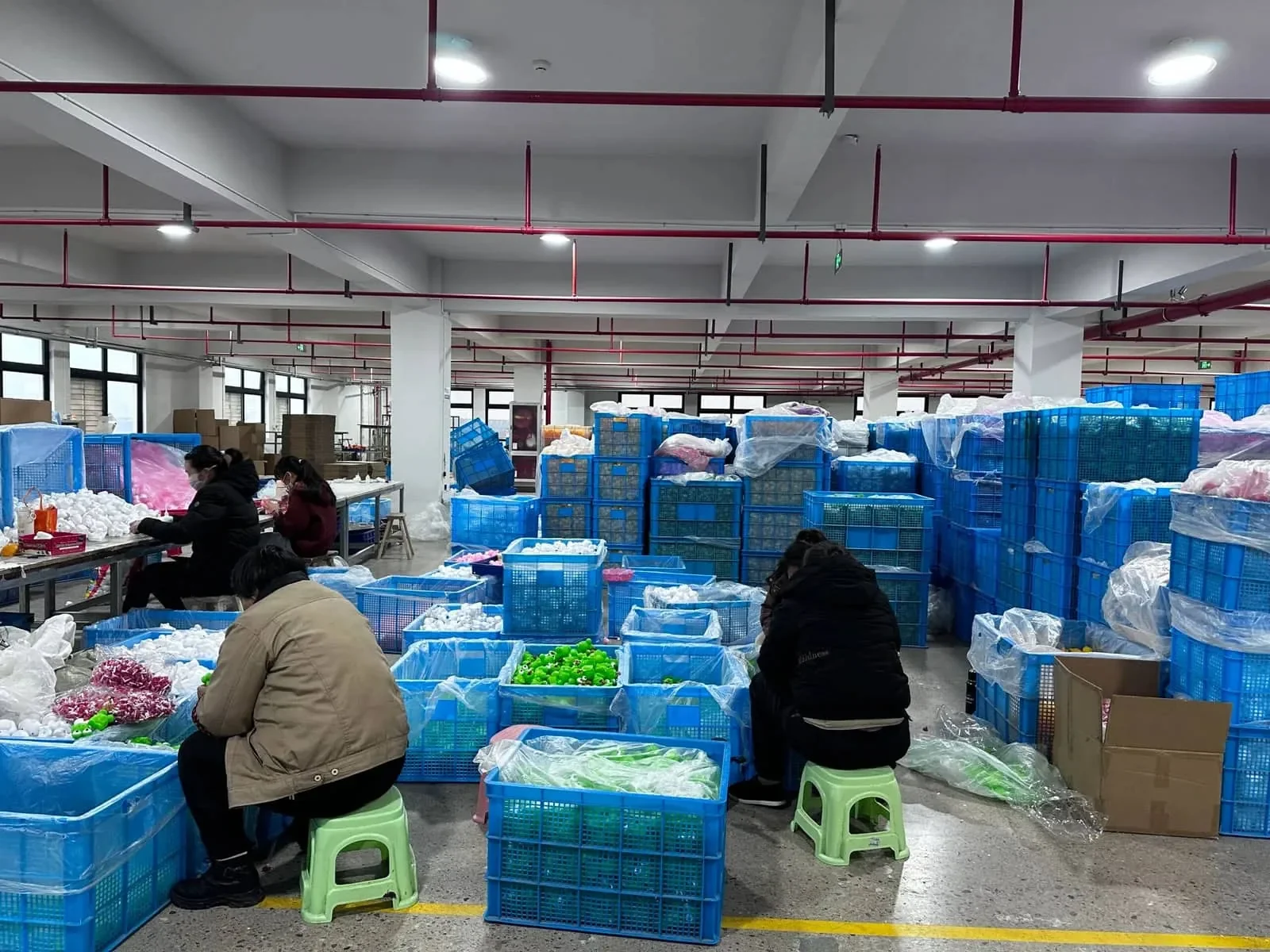
The first file answers a question that sounds trivial and is not: which legal entity will make the duck, and which address will appear on the paperwork. A trading company can be an excellent counterparty, but the audit has to know which role it is dealing with, because the duty to produce the approved type sits with the manufacturer while the certificate duty sits with the importer in many markets. A buyer who does not know which company owns the machines cannot check anything downstream.
Three questions belong here. Who owns the company, and is it the same entity named on the certificate? Where is the plant, and can the address be matched to a packing list or a shipping document? What can the plant actually make — which processes, which sizes, which finishing steps are done on site and which are bought in?
The answers are all documents: a business licence, a plant address that appears on official paper, and a process list that can be walked one day. The China factory versus local supplier note covers how the two roles differ in practice, and it is worth reading before the first call rather than after the third.
File two: the compound, the tool and the colour reference
The second file is where a duck becomes a specific object rather than a type. Three questions: which compound is specified, and is there a safety data sheet for it; which mould will run this duck, and who owns it; which colour reference is recorded, and against what standard. Each answer is a document, and each document is checked against the duck rather than against the supplier's description of it.
Colour is the one buyers underestimate. "Yellow" is not a reference. A recorded colour standard, a dated chip and a light source under which the comparison was made are a reference, and the colour matching note explains why the difference matters at the approval stage rather than at the goods-in stage.
The tool question is a document question as well, because a mould number ties a duck to a steel block and a location. A factory that cannot name the tool is a factory that cannot tell you what will happen to your duck when the tool needs repair. What a buyer wants from this file is not a promise of quality but a set of numbers and references that another party could check independently.
File three: the test report and the certificate
The third file is the one buyers ask for first and read last. Four questions: which product does the report name, and does it name this material and this age grade; which sections of the standard does it cover and which does it leave out; when was it issued, and is it the version now required; who signs the certificate, and whose name and address appear on it.
The rules behind it are worth knowing in outline. In the United States, ASTM F963 is a mandatory consumer product safety standard for children's toys, codified at 16 CFR part 1250, and a toy is an object designed, manufactured or marketed as a plaything for children under 14 (CPSC toy safety). The manufacturer or importer certifies the product on the basis of passing test results, and the certificate has to accompany the product or the shipment, with a copy available to retailers and distributors (CPSC testing and certification).
That is why the report's scope matters more than its cover page. A certificate that accompanies a shipment is a statement about that product on that date. A report written for a different compound, a different mould or a different age grade is not evidence about your duck, however official it looks. Ask for the page that names the product, not the page with the logo.

File four: the sample record and the inspection plan
The fourth file is what most audits leave out, and it is the one that predicts what the second run will look like. Two questions: which duck is the retained standard, and where is it kept; and what is the inspection plan — which stages, what sampling, who records the result.
A sample is a proposal; a retained, dated and bagged standard is a record. The difference is not procedural fussiness: a sample that has been handled by four people for two years has picked up marks that make it a poor comparison, and a buyer who compares a new carton against it will argue about the wrong things. The sample bag versus production run note covers what sits between an approved duck and a production one, and the sample approval note covers what a written approval should contain.
The inspection plan is a document in the same way. It names stages, it names a sampling rule, and it produces a record with a signature on it. Where the factory's own inspection sits in the run is covered in the inspection note, and the plan is what a buyer reads when they want to know which of those stages will actually happen on their order.

File five: the terms that belong in writing
The fifth file is short and it is the one that decides what happens when something goes wrong. Three questions: what is written about the tool and the artwork, and who owns each; what happens when a carton fails, and who decides on what evidence; and what notice applies if the compound, the plant or a subcontractor changes.
None of those three is a trust question. A buyer who trusts a supplier completely still wants the answer in writing, because the person who answers today may not be the person answering in eighteen months. Ownership of the mould is the clearest example: a tool that belongs to the factory is a tool that leaves with the factory, and the terms are where that is either settled or left to be discovered later.
The signature test for this file is simple. If the answer would still be enforceable with a different account manager on both sides, it is a term. If it depends on a conversation, it is a hope. Writing the five files down is also what makes the next audit shorter, because the second file is a revision rather than a new build.
The fifteen questions, and what a real answer looks like
The table below is the audit sheet in its shortest usable form. The left column is the question, and the right column is the object that settles it, because a question without a document attached is an invitation to a paragraph.
| Question | What a real answer is |
|---|---|
| Who owns the company, and is it the entity on the certificate? | A registration document and a named signer that match |
| Where is the plant, and does the address match the shipping documents? | An address that appears on official paper and on the packing list |
| What can the plant make, and what is bought in? | A process list with the on-site steps separated from the subcontracted ones |
| Which compound is specified? | A material name or code plus a safety data sheet for that compound |
| Which mould will run this duck, and who owns it? | A tool number and a written ownership statement |
| Which colour reference is recorded? | A dated standard chip and the light source used for comparison |
| Which product does the report name? | A report whose product, material and age grade match the duck being bought |
| Which sections does the report cover? | A clause list, including the sections that were not tested |
| When was the report issued, and is it the current version? | An issue date read against the version now required in the destination market |
| Who signs the certificate, and whose address appears on it? | A signature block with the legal entity and address, not a logo |
| Which duck is the retained standard, and where is it kept? | A dated, bagged duck with a named holder |
| What is the inspection plan? | Stages, sampling rule and a record with a signature |
| What is written about the tool and the artwork? | Terms that name the owner of each and what happens if the relationship ends |
| What happens when a carton fails? | A written process with the decision-maker and the evidence required |
| What notice applies if the compound, plant or subcontractor changes? | A notice period and a written approval step |
The fifteen answers are not equally important, and that is why the file structure matters. A perfect answer on colour does not compensate for a missing report scope, and a missing tool number cannot be repaired by a second sample. Score the file by what exists, not by how well the answer was phrased.
What the absences add, and how to score the answers
A shortlist is easier to run against absences than against claims. Five absences are worth slowing down for, and each one has a specific document that would clear it. A certificate that names a product category rather than your duck. A colour recorded as a word. A plant that cannot be named. A photograph treated as an approval. Nothing kept from the approved run.
Scoring works best on a three-point scale per file: present, partial, absent. Present means a document with a holder, a scope and a date. Partial means an explanation with a promise attached. Absent means silence, and silence in the first exchange is the most useful answer a supplier can give, because it tells the buyer which file has to be built from zero.
Run the score at the shortlist stage rather than the order stage. A file that is complete at the shortlist stage is a file that can be refreshed later; a file that is assembled in a rush after the order is agreed is usually a set of documents written for a different product.
Five questions to take into the decision
- Which of the five files arrived complete, and which one arrived as an explanation?
- Does the report name this duck, this material and this age grade, or only the category?
- Can the plant be named, located and matched to the shipping documents?
- Is there a retained standard duck with a date, a bag and a holder?
- Are the tool, the artwork and the failure process written down rather than described?
Final Note
An audit is a reading exercise, not an interview. The supplier who sends five files and one honest gap is easier to work with than the one who sends a fluent page and no documents, and the gap is not a disqualification — it is the thing the buyer now knows to build.
I would rather sign with a factory that has an incomplete file it can explain than with one whose file is complete on the first attempt and impossible to verify. The first is a relationship with a to-do list. The second is a relationship with a question nobody has asked yet.
Frequently Asked Questions
Is a test report the same as a certificate?
No. A test report records what a laboratory tested on a sample against named clauses. A certificate is the declaration that the product conforms, signed by the responsible party, and it has to accompany the product or shipment in the markets that require one. Buyers need both, and need to read the report's scope before treating either as proof.
How do I check a report is for my duck?
Read the product description, the material, the age grade and the issue date on the report itself, then compare them with the duck in the sample bag and the compound on the safety data sheet. A report whose product description is a category rather than a product is a report that does not answer the question.
Do I need to visit the factory?
Not to complete the audit. Most of the five files are documents, and a visit cannot replace a missing report scope or an unnamed tool. A visit is useful for the process list and for the questions the documents raise, which is a different and later step.
What if the supplier cannot provide one of the files?
Record it as absent and ask what it would take to produce it, because the answer is diagnostic. A file that can be produced with a date attached is a scheduling question. A file that cannot be produced at all is a question about whether the product is what the supplier says it is.
Key takeaways
- An audit is a document trail, not a questionnaire: an answer you cannot file is a claim.
- File one: who the factory is: the entity on the certificate has to be the entity that makes the duck.
- File three: the test report and the certificate: read the scope, not the cover page.
- The fifteen questions, and what a real answer looks like: every question has an object attached.
- What the absences add, and how to score the answers: score present, partial or absent per file.