What a company gift has to get right before the holiday calendar closes.
A Q4 appreciation duck has to survive February in daily use, and that test is decided at artwork. A personal line and a size that fits the handout matter more than the wrapping.
In short: A custom duck works as an employee appreciation gift when it carries a personal line, one clear mark and a format that suits the handout. The programme file has to fix the recipient list, the personal layer, the pack format and the safety position before the design is drawn. Get those four right and the gift survives the desk; leave them to the week before the party and it becomes another item in a bag.
Q4 is a deadline, not a gift strategy
The fourth quarter compresses everything. Budgets are confirmed late, recipient lists change, and the gift has to arrive between a holiday party and a shipping calendar that is already full. The duck order is not competing with other gifts for attention; it is competing with every other Q4 order for a place in the schedule.
That is why the programme starts with a date rather than a design. Work backwards from the handout: the cartons have to be in the building, the cards have to be printed and the names have to be checked. A duck that arrives after the party is a gift for the next quarter, and the good will it was meant to carry has already been spent.
The Q4 order timing notes set out where the calendar usually pinches. The programme owner does not need a manufacturing schedule; they need one date and a decision that the gift is happening.

What makes a gift survive on a desk
A desk has very little free space and a lot of small objects competing for it. The gifts that stay tend to share three properties: they are small enough to sit beside a keyboard, they do something visual without needing to be used, and they explain themselves.
A duck has the first two by nature. The third is the programme's job. A duck with no card is a toy that appeared one day; a duck with one line that says why it arrived is a reminder every time it is moved. The card is not decoration, it is the part that turns an object into a message.
The mark matters for the same reason. One approved variant, printed where it can be read from a seated position, does more than a chest covered in type. The brand page notes cover how the variant is chosen; the gift programme only has to use it.

The personal layer: names, teams and milestones
Personalisation is where a gift programme either becomes specific or becomes expensive bureaucracy. There are three layers worth considering, and each has a different tolerance for change.
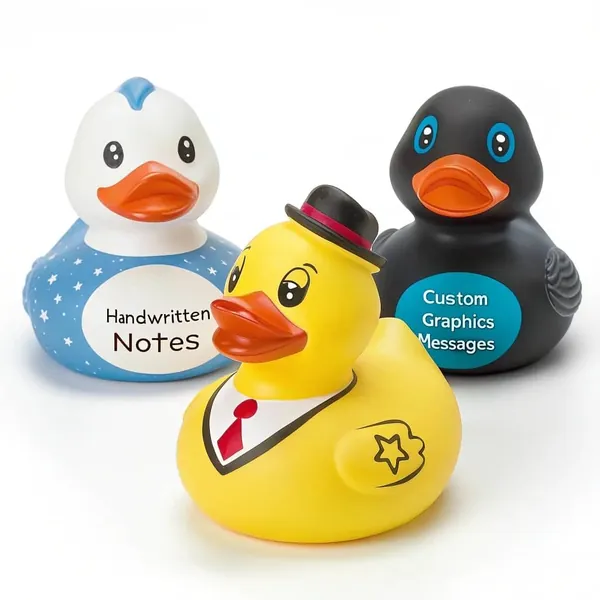
The first is the team or department printed on the duck. It is one line of type, it is the same for everyone in the group, and it survives a late change in the recipient list. The second is the milestone: years of service, an anniversary, a project number. That belongs on the card or the base, where it can be checked against a list rather than reprinted on a body.
The third is the individual name. It is the most personal and the least forgiving, because every spelling has to be confirmed and every late joiner becomes a new print version. If the programme wants names, the list has to be locked before the files are sent, and the proof has to be read back by the person who owns the list.
The anniversary source programme solved this with two audiences in one run: a small number for the milestone recipients and a larger number for the wider team, with the number and the mark doing the work. The gift set notes show how a box changes the perceived value without changing the duck.

Handing out forty or four hundred
The handout format decides as much as the design. Forty gifts can be bagged by hand at a desk; four hundred need a pack that closes, stacks and carries a label, or the distribution becomes an afternoon of matching bags to names.
Three formats cover most programmes. A polybag with a header card is the simplest to assemble and the easiest to hand out, but it reads as a giveaway. A printed box reads as a gift and takes more volume in storage. A small kit, with the duck and a card in a box or a pouch, sits between them and is the format most likely to be kept, because it looks intentional when it is opened.
The recognition programme source adds a cadence point: a monthly token that arrives on time beats an annual award that arrives late. If the duck is part of a recognition rhythm, the format has to be repeatable, with the same pack and the same card, so the fifth one still feels like the programme rather than a leftover.
When the duck goes home with a family
The recipient is an adult, but the duck may not stay with the adult. It goes on a desk, into a bag, and often home to a child. That possibility changes the compliance question, and the programme should decide it before the artwork is approved.
The CPSC toy safety guidance defines a toy by how a product is designed, manufactured or marketed for children, which means a company gift can become a children's product through its packaging or its promotion. If the duck is likely to be given to a child, treat it as a toy from the start: age grade, warning where required, and the material limits that go with the grade.
The material line matters as much as the label. 16 CFR 1307.3 prohibits the sale of a children's toy containing more than 0.1 percent of DEHP, DBP or BBP, so a duck aimed at a household with children should sit on a compound that the factory can document. That is a question for the spec card, not for the packing line, and the toy safety label guide lists the marks that follow from the answer.
What a company gift should not carry
A gift should not carry a sales message. The moment a duck is printed with a call to action, a campaign hashtag or a landing page that nobody maintains, it stops being a thank you and becomes a leaflet with a beak. The recipient can tell the difference, and the object loses the one thing that made it worth keeping.
It should not carry a second logo either. A co-branded gift is a negotiation, not a design, and the duck is too small a surface for two marks to share. If a partner has to appear, put them on the card, where the type can be read.
The pack has the same rule. A box that needs scissors, a bag that tears at the corner or a card that falls off in transit turns the gift into a chore at the moment it is received. The packaging notes cover the formats that survive a commute. The same format logic applies to onboarding duck kits, which face a different deadline but the same assembly question.
The Q4 gift file
The file is small and it decides everything. It should be one page that the programme owner, the brand team and the packer can all read, and it should name a signer for each line.
| Item | What it fixes | Who signs |
|---|---|---|
| Recipient list | Who receives one, and at which tier | Programme owner |
| Mark | The one approved variant and its surface | Brand team |
| Personal layer | Team, milestone or name, and the spelling source | HR or the list owner |
| Format | Bag, box or kit, and the label position | Programme owner |
| Age position | Whether the duck may reach a child | Compliance |
| Card copy | The single sentence that explains the gift | Communications |
| Carton split | How the boxes are divided by site or floor | Logistics |
Once the table is filled, the design brief writes itself. The duck, the card and the pack are three decisions that have already been made, and the factory is not being asked to guess which one matters.

Five questions the programme owner should answer
Each answer removes a decision from the week before the party, when there is no time left to make it.
- Who is on the list, and who owns the final spelling of every name?
- Which single mark goes on the duck, and which surface carries it?
- Is the gift a bag, a box or a kit, and who assembles it?
- Could the duck reach a child, and if so, what age grade applies?
- Who signs the card copy, and who checks the cartons against the sites?
Frequently Asked Questions
Why give a rubber duck as an employee gift?
It is small, durable and visible on a desk, and it carries a printed line without needing a screen. That combination makes it a better desk gift than an object that is used once and stored. The gift still needs a reason on the card, or it reads as a novelty.
Can every duck in the order carry a different name?
Technically yes, but the proof and the packing become the work. Each name is a separate print version, so the list has to be locked and read back before the files are sent. For large programmes, a team line on the duck and the individual name on the card is the more reliable split.
How should company ducks be packed for a handout?
Choose a format one person can carry and hand over without assembly. A bag with a header card works for small programmes; a printed box or a small kit reads better and stores well. Label the cartons by site or floor so the handout does not become a sorting exercise.
Is a company duck a children's product?
It depends on how it is designed, packaged and promoted. A gift marketed to adults is not automatically a children's toy, but if it is likely to reach a child, the age grade and the material limits apply. Decide that before the artwork, not after the cartons arrive.
Final Note
A Q4 gift programme is a small logistics project with a emotional purpose, and the duck is the part people remember. The programme that works is the one that decides the list, the line, the pack and the safety position early, then lets the object do its job.
I would rather see a plain duck with a name spelled correctly than an elaborate series that arrives after the party. The list, the line, the pack and the age position are the four things that decide the outcome, and all four are settled long before anything is moulded. The desk is the test, and February is the verdict.
Key takeaways
- Q4 is a deadline, not a gift strategy: The fourth quarter compresses everything.
- What makes a gift survive on a desk: A desk has very little free space and a lot of small objects competing for it.
- The personal layer: names, teams and milestones: Personalisation is where a gift programme either becomes specific or becomes expensive bureaucracy.
- Handing out forty or four hundred: The handout format decides as much as the design.
- When the duck goes home with a family: The recipient is an adult, but the duck may not stay with the adult.
- What a company gift should not carry: A gift should not carry a sales message.
- The Q4 gift file: The file is small and it decides everything.
- Five questions the programme owner should answer: Each answer removes a decision from the week before the party, when there is no time left to make it.