A cracked giant duck is usually an assembly failure before it is a material failure. The shell is the part everybody photographs, but the crack usually starts where something else met the shell: a bracket, a bolt, a gasket that was not there, or a gap that was filled with tension instead of clearance.
That order matters because it changes what a buyer can do about it. A shell that cracked because the compound was wrong is a batch problem. A shell that cracked at a bracket because the bolt was over-tightened is an installation problem, and installation problems repeat on every site until the drawing changes.
In short: most giant duck cracks start at a joint, not in the middle of a panel. Check the torque on every bolt at the mount, put a gasket between the bracket and the shell, leave an expansion gap for the temperature range the site actually reaches, and keep the shell out of long sun between bookings. The material decides how far a crack travels, but the assembly decides whether it starts.
A giant duck is a structure with a face on it

The first thing a buyer has to accept is that a large duck is not a toy scaled up. It is a shell with lifting points, mounts, a base and a surface finish, and it is judged as a structure by the people who install it. A small duck can be squeezed and dropped without consequence. A large one is lifted, bolted and left outdoors.
That changes the order of the review. Wind load, the fixings, the lifting points and the base come before the artwork, because a duck that is not safe to stand up does not get to show its print. The installation note for city and mall ducks covers the site side of that conversation, and it is the right page to read beside this one.
It also changes who owns the crack. If the site changed the mount and did not tell the factory, the shell is being asked to do something the drawing never covered.
Where a giant duck cracks
| Location | What fails first | Why it fails | What to change |
|---|---|---|---|
| Bolt at the bracket | The shell around the hole | Point load, over-torque or a bolt that loosened and re-tightened itself | Torque range written down, checked with a wrench |
| Bracket against the shell | The shell surface | Two different materials rubbing, no gasket | A gasket on every bracket face |
| Seam | The joint line | The seam carries load it was not designed for | Keep the seam away from the mount |
| Base | The seat | Standing water, dirt, an uneven slab | A base that drains and a flat pad |
| Sun-facing panel | The surface | UV exposure over seasons | Stabilised compound and storage out of sun |
| Lifting point | The eye or the shell around it | Lifted by the body instead of the point | Mark the points and forbid body lifts |
Read the table down the left column. Only one of those six is a compound question. The other five are design, installation or handling questions, and they are the ones a buyer can still influence before the duck ships.
The seam is the weakest line on the shell

A seam is a joint, and a joint is where two surfaces had to meet exactly. On a large shell the seam runs a long way, and the longer it runs, the more chance there is of a thin spot, a step or a place where the material did not knit. That is the line a crack will follow if it is given a reason.
The reason is usually load. A seam that sits under a bracket, or a lifting point that pulls across a seam, turns a cosmetic line into a structural one. The fix is a drawing decision: move the mount, move the seam, or put a doubler behind the joint so the load lands on a continuous area.
The second reason is handling. A seam that gets dragged across a kerb or dropped onto a pallet edge will start a crack that grows in service, which is why the durability tests that include a drop and a squeeze belong in the same conversation as the drawing.
Torque is the number nobody checks
Ask a crew what torque they used and the answer is usually a wrist. Ask again at the next site and the answer is a different wrist. That is how a mount that was designed for a controlled load ends up crushing the shell at one corner and leaving a bolt loose at the other.
Torque matters for two reasons on a large duck. Too much crushes the shell around the hole and starts a crack at the edge of the washer. Too little lets the joint work, and a working joint is a slow saw that removes material a little at a time, especially on a duck that moves in wind.
The control is boring and it works: a stated torque range in the install document, a torque wrench on the crew list, and one person who signs the sheet at the end. If the range is not written down, the crew is not being careless, they are being asked to guess.
The gasket is the smallest part in the box
A gasket does three jobs at once on a large duck. It separates two different materials so they cannot rub, it spreads the clamp load of a bolt over a wider area, and it takes up the small irregularities between a bracket and a curved shell so the joint does not rely on one contact point.
Skipping it is a common shortcut because the joint looks tight without one. It is tight at the bolt and open everywhere else, and the open part is where water sits, where grit works in and where the shell starts to craze around the fixing.
The material matters less than the presence. A firm rubber or a dense foam works; what fails is the assembly with nothing between the metal and the plastic. A wall thickness decision behind the bracket matters just as much, because a thin panel with a gasket still flexes under load.
Leave a gap for the heat
A large shell moves when it gets hot. Every material in this trade expands and contracts over a day and night cycle, and a panel several feet across moves more than the small part a buyer is used to handling. A mount that is tight at the morning temperature is a mount that is loaded by the afternoon.
The fix is a clearance, written as a number in the install drawing, at every fixing that is not meant to be rigid. Slotted holes, oversized washers and a specified gap all do the same thing: they let the shell move without fighting the bracket.
This is where a site visit earns its place. A drawing that assumes a shaded plaza is wrong for a car park in direct sun, and the temperature range the duck will actually meet is a fact about the site rather than about the mould. Write it down and pass it to whoever sets the clearances.
UV makes the shell brittle before it cracks

Sun is the slow failure. A shell that sits out for a season takes UV the same way a small duck on a dashboard does, and the visible sign is a change in colour before the mechanical sign appears. By the time a surface looks chalky or washed out, the outer layer has already lost some of the flexibility that let it flex instead of splitting.
The answer is partly in the compound and partly in storage. A PVC duck made for outdoor display is normally built with a stabiliser package for that job, which the masterbatch and UV note explains, and a duck stored in a dark warehouse between bookings ages much more slowly than one left assembled on a trailer.
The failure that surprises buyers is the one that appears after reinstallation. A shell that has been in the sun for a year is less able to absorb the same clamp load it took when it was new, which is why the torque sheet should be re-run at every install rather than copied from the first one.
What the size band changes

The size of the duck changes which part of the structure matters. A duck in the larger size bands is a shell that people climb on, lean against and photograph with a crowd around it, so the base, the mounts and the lifting points carry loads a tabletop duck never sees. A duck at the smaller end of the range is often a display piece that only has to sit still.
The process follows the size. A very large shell is usually built in a way that suits a low volume and a big mould, and the process comparison explains what that does to the wall and the seam. A small duck can be made in a tool that runs a higher volume, with a thinner wall and a tighter seam.
The mistake to avoid is specifying one size band's drawing for the other. The mount that is right for a large duck is overbuilt and wrong for a small one, and the reverse is a safety problem rather than a nuisance.
The small ducks in the campaign
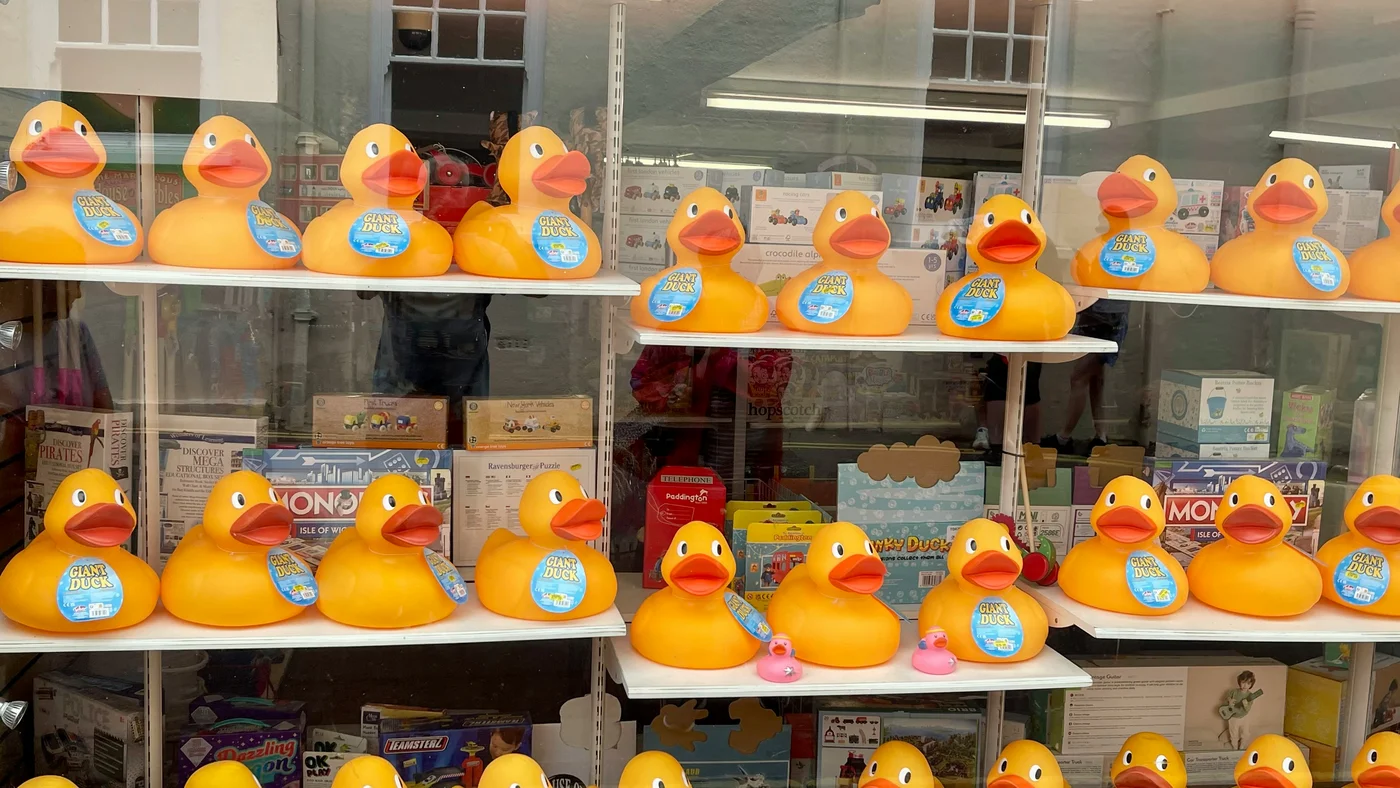
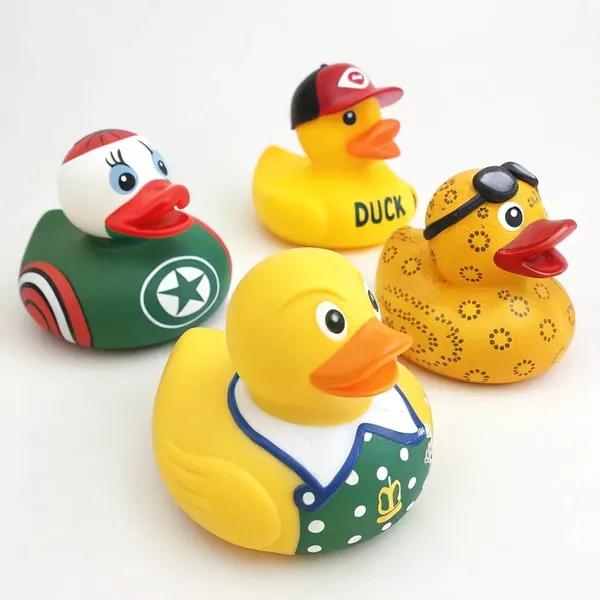
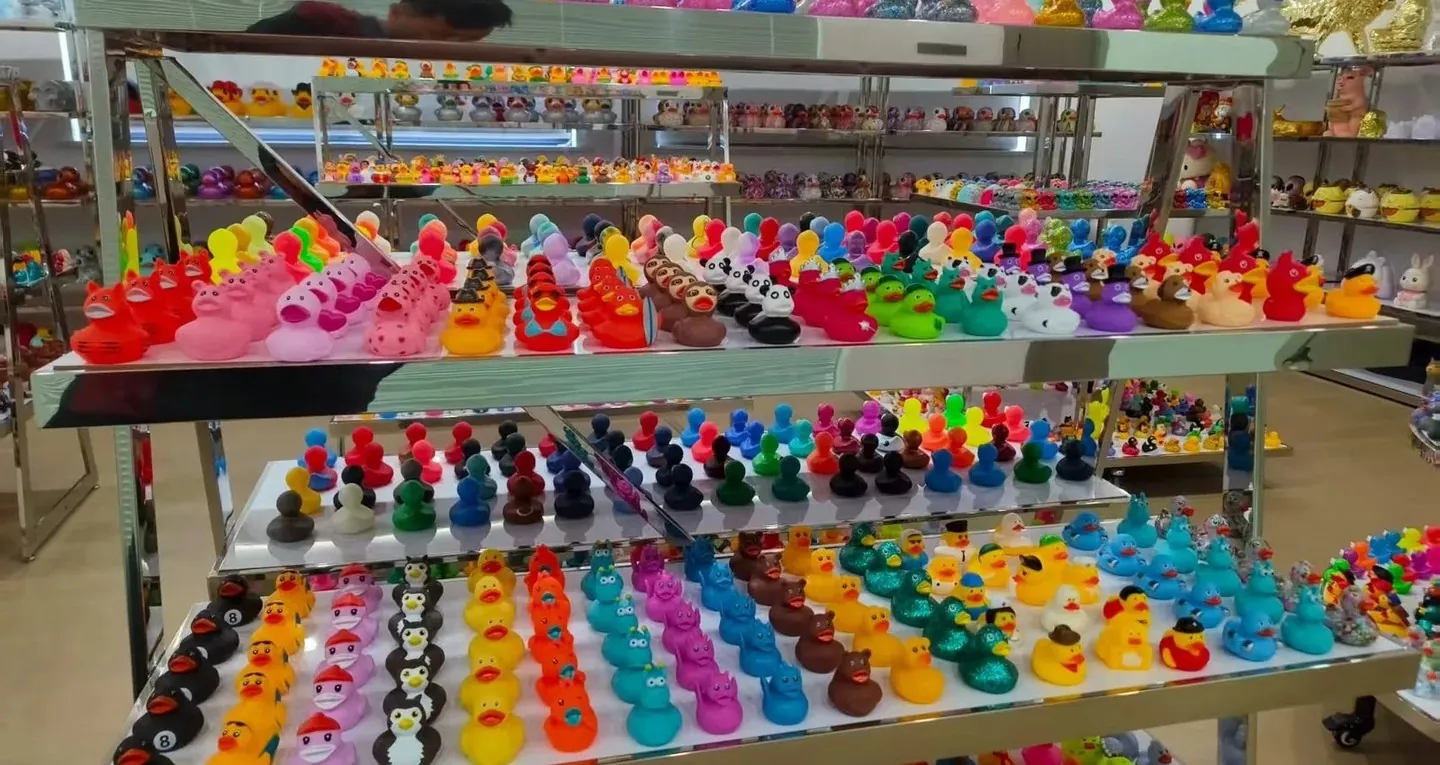
A campaign with a giant duck almost always has small ducks beside it: giveaways, staff gifts, retail packs, photo-op props. Those ducks are made in a different tool and judged by different rules, and the only thing they share with the big one is the artwork.
That sharing is worth controlling. If the small ducks are made from the same artwork and the same colour reference, a buyer gets a campaign that reads as one object rather than two. If the giant duck is a different colour system from the small ones, the photographs will show it.
The wholesale note for large ducks covers how the big duck is specified and bought, and the small ones stay on their own specification sheet.
What to check before the duck goes up
A short list, and every item on it is a question the drawing can answer before the crew arrives.
- Where does the shell meet the mount, and is there a gasket between the bracket and the plastic?
- What is the bolt torque range, who checks it, and is a torque wrench on the crew list?
- Where are the lifting points, and is anyone allowed to lift the duck by the body?
- What expansion gap is specified at each mounting point for the site's temperature range?
- What is the shell rated for in sun, and how is it stored between bookings?
Two of those questions are about paper rather than about the duck, and they are the ones that get skipped. The inspection note covers how the checks are recorded before the duck leaves, and the transport frame is what protects the seam on the way.
What the rules attach to a broken surface
A shell that cracks can produce a sharp edge, and a sharp edge on a toy is a regulated hazard rather than an opinion. In the United States, the eCFR text of 16 CFR Part 1500 contains the sharp-edge and sharp-point methods used to judge toys for children under eight, which is the standard a cracked shell is being measured against when a buyer asks whether the damage is cosmetic.
Transport is the other half of the same story. A large duck is a parcel before it is an installation, and the ISTA packaging test standards are the frame the industry uses to check that a pallet survives the trip. A seam that arrives already stressed is a seam that cracks in service, so the drop and the vibration check belong before the install, not after.
Frequently Asked Questions
Why did the duck crack in the first week?
The first week is when the assembly is still settling. A crack that appears that fast is usually at a fixing, either crushed by torque or working because the joint was loose, and it is rarely a batch fault in the compound. Pull the torque sheet before pulling the material report.
Should the mount be rigid or flexible?
Rigid enough to hold the duck still, and never so tight that the shell cannot move with temperature. That is what slotted holes and a stated clearance are for, and it is why the mount drawing has to carry the site's temperature range.
Does a thicker wall stop cracking?
It helps at the fixing and hurts nothing but weight, and it is not a substitute for a gasket or a torque range. A thick panel with an over-torqued bolt still cracks at the washer edge, because the load is concentrated rather than spread.
What about the small ducks in the same campaign?
They are a separate tool, a separate specification and a separate approval. Keep the artwork and the colour reference shared so the campaign reads as one, and keep the drawings apart so a mount for a large duck never lands on a small one.
Final Note
My own order on a cracked duck is to look at the joint before the material. It is the less flattering answer, because it usually points at a drawing or a wrench rather than at a compound, and it is also the answer that prevents the second crack.
A giant duck is judged in a photograph and remembered for how it stood up. The shell gets the credit and the joint decides it.
Key takeaways
- A giant duck is a structure with a face on it: The first thing a buyer has to accept is that a large duck is not a toy scaled up.
- Where a giant duck cracks: Read the table down the left column.
- The seam is the weakest line on the shell: A seam is a joint, and a joint is where two surfaces had to meet exactly.
- Torque is the number nobody checks: Ask a crew what torque they used and the answer is usually a wrist.
- The gasket is the smallest part in the box: A gasket does three jobs at once on a large duck.
- Leave a gap for the heat: A large shell moves when it gets hot.
- UV makes the shell brittle before it cracks: Sun is the slow failure. A shell that sits out for a season takes UV the same way a small duck on a dashboard does, and the visible sign is a change in colour before the mechanical sign appears.
- What to check before the duck goes up: A short list, and every item on it is a question the drawing can answer before the crew arrives.