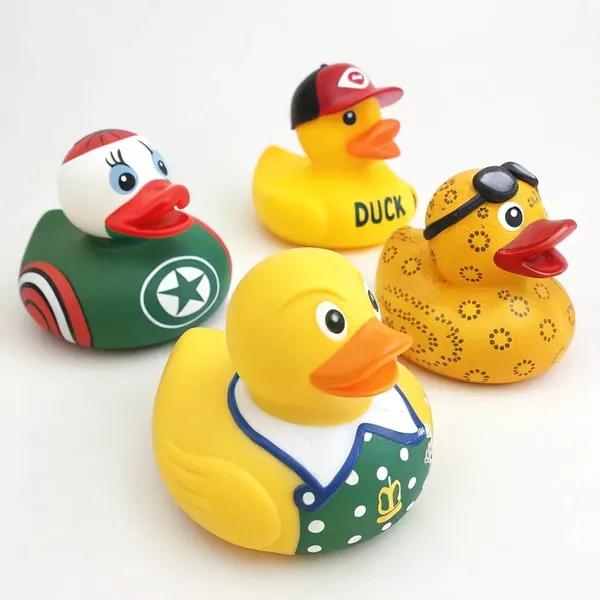
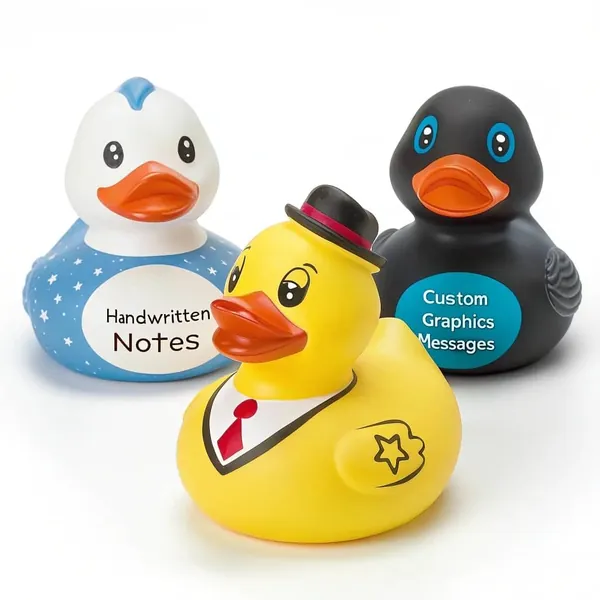
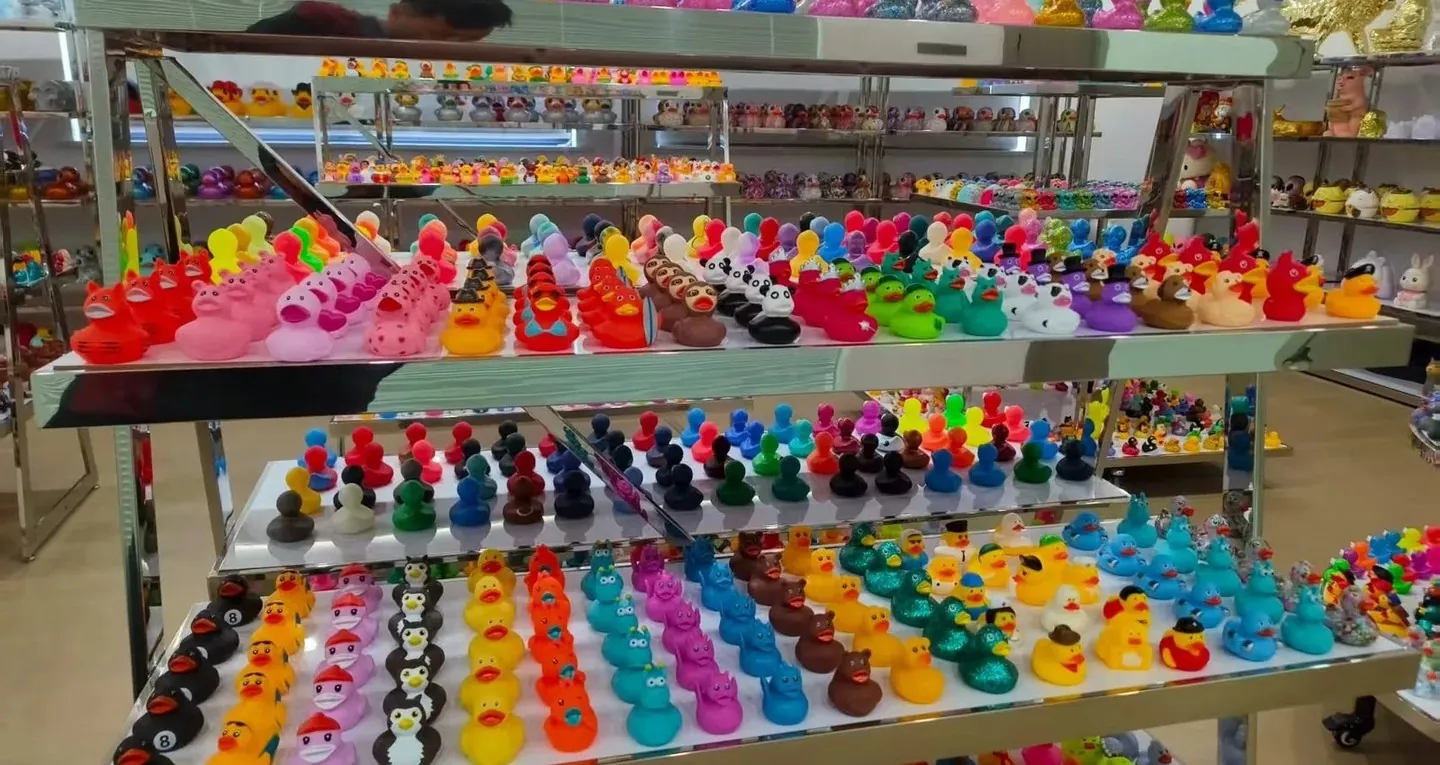
Five marks on the body separate a rotocast duck from an injected one, before the print is read. The body tells you which process made it, and the process tells you what the duck can do in the hand.
That is the useful way into this comparison. The two routes are not competing for the same job. One makes a hollow shell that squeezes and floats. The other makes a solid part with a different set of marks, a different wall and a different set of details it can hold. The decision follows the product, not the machine list.
In short: rotocasting makes a hollow, seamless-bodied shell with a closed wall, so the duck squeezes and floats. Injection molding makes a denser part with a gate mark, tighter detail and a different wall, and it is usually the better route for small parts, inserts and higher volume. Choose by what the duck has to do, then let the marks confirm the route.
Two routes make two different bodies

The two processes differ in how the material reaches the shape. Rotocasting puts a measured charge of compound into a closed mould, heats it and turns the mould so the material coats the inside and builds a wall. Injection molding forces molten material into a closed cavity under pressure, fills it and cools it.
Everything a buyer notices follows from that difference. A rotocast body is a shell with air inside, so it squeezes, recovers and floats. An injected body is filled, so it is denser, holds detail more crisply and takes inserts more easily, and it does not have the same air pocket to squeeze.
Neither is better in the abstract. A bath duck and a keyring charm are both rubber ducks and they want different routes.
The five marks, side by side
| Mark on the body | Rotocast shell | Injection molded part |
|---|---|---|
| Parting line | Present, along the mould split | Present, along the tool split, often sharper |
| Fill or gate mark | A small witness where the charge went in | A gate vestige where the material entered |
| Wall | Built up by rotation, closed and hollow | Set by the cavity, solid or with a designed void |
| Moulded detail | Softer edges, less undercut | Crisp edges, undercuts and fine features |
| Separate parts | Fewer, because the shell is one piece | More, because inserts and assemblies are easier |
| Squeeze and float | Yes, the shell holds air | Only if a void is designed in |
| Typical use | Bath toys, floats, giveaways | Charms, keyrings, small dense parts, inserts |
The table is the short version of the article. What it cannot show is how the marks differ in practice, which is what the next five sections are about.
The first mark is the parting line

Every mould that opens in two halves leaves a line where the halves met. On a rotocast duck the line is usually softer and slightly rounded, because the material coats the inside and the seam is formed by two surfaces meeting under low pressure. On an injected part the line is sharper, because the tool is clamped hard and the material is pushed against it.
Why it matters to a buyer is placement, not existence. A line across the neck, under the beak or down the side is a place where paint will not sit evenly and a logo will not print cleanly. Moving the line is a tool decision, and it is worth making before the artwork is final.
The line is also a wear point. A tool that has run a long time closes slightly differently, and the line gets heavier. The mould ownership note and the stock or custom tooling note both touch on what a second order inherits from the first.
The second mark is the fill hole or the gate
A rotocast mould has to be filled, and the opening where the charge went in leaves a witness, usually on the base or at a hidden point. An injected part has a gate, and the gate leaves a small vestige where the material entered the cavity, positioned by the tool designer rather than by chance.
The buyer's question is whether the mark is hidden. On a duck that will be held and turned over, a gate on a visible surface is a defect that shows up in every photograph. On a part that sits in a bag or on a keyring, a gate on the back is nothing.
The mark also tells you the tool's age. A gate that has been trimmed by hand looks different from one cut by the tool, and a batch with both is a batch that was partly reworked.
The third mark is the wall

The wall is where the two routes diverge most for a buyer, because it decides feel and float. A rotocast wall is built by rotation, so it is closed and hollow behind, which gives the body its squeeze and its buoyancy. An injected wall is set by the cavity and is filled, so the part is denser and does not squeeze the same way.
That difference is why two ducks of the same size can weigh different amounts, which is a freight question as much as a feel question. A hollow shell packs volume without mass, and a solid part packs mass. The wall thickness note and the shore hardness note are the two pages to read together here, because the wall and the compound decide the hand together.
The fourth mark is the moulded detail

Injection molding holds fine detail better than rotocasting, and that has a commercial consequence. Eyes with a defined lid, a moulded logo with a sharp edge, a hat with a clean brim and a beak with a crisp line are all easier in an injected tool, because the material is pressed into the cavity rather than coating it.
Rotocasting can hold detail, and the detail is softer. That is not a fault; it is the nature of a shell formed by coating. A buyer who wants a crisp moulded logo on a squeezable body is asking for two processes in one duck, and the answer is usually a printed mark rather than a moulded one.
This is the section where a proof matters more than a promise. If the detail is the reason for the duck, ask for it on a sample from the tool rather than on a drawing.
The fifth mark is the parts that are not the body

A duck is rarely one part. A squeaker, a valve, a weighted base, a hat or an insert all have to be placed, and the process decides how easily. Injection molding takes inserts and small separate parts more easily, because the tool can be built around them. Rotocasting works with a closed mould, so anything inside the shell has to be designed in from the start.
The squeaker is the classic example. A shell that squeezes needs a way for air to leave and return, and the valve note covers how that is designed. A part that a child could pull out is a small-part question, and in the United States the eCFR text of 16 CFR Part 1501 sets out how that hazard is identified for toys for children under three.
What no mark on the body can tell you
The marks tell you the route. They do not tell you whether the duck is safe, whether the colour will hold or whether the batch matches the sample. A part can be beautifully moulded and fail a pull test, and a shell can be perfectly formed and use a compound that goes brittle in the sun.
CPSIA section 106 duties are summarised in our toy safety guide.
Colour and print are separate again, and the compound comparison is where the material question belongs.
Which route the design already assumes
A design usually implies its route before anyone chooses one. If the sketch has a hollow body with a squeaker and a flat base that floats, it is a shell, and that points at rotocasting. If the sketch is a small dense charm with a crisp moulded edge and an insert, it is an injected part.
The middle case is where buyers get stuck: a duck that has to squeeze and also carry a crisp moulded logo with a separate hat. That is the point to stop and choose, because the answer is usually a compromise rather than a single process. The multi-part note is the page for that conversation.
A third case is a duck that already exists. If the body is in a stock tool, the process question is closed and the only open question is the print, which is a different article.
What I put in a process brief
A brief that names the process saves a round of samples. Four questions decide it, and each one has an answer that points at a route.
- Does the duck need to squeeze and float, and is the air pocket designed in?
- Which detail is cut into the steel, and which one belongs in the print?
- Which parts are separate, and who checks them once they are assembled?
- Which mark has to be hidden, and where does the print sit against the seam?
The prototype note covers what can be settled before a tool exists, and the squeeze and drop tests cover what the finished part has to survive.
Frequently Asked Questions
Why does my rubber duck have a line around its neck?
That is the parting line, where the two halves of the mould met. On a shell it is usually soft and on an injected part it is sharper. Its position is a tool design decision, and a line in a place where paint or print has to land is worth moving before the artwork is finished.
Can an injection molded duck squeeze?
Only if a void is designed into it, which makes the part a shell in practice rather than a solid. A solid injected part does not have the air to displace, so it feels dense and does not recover the way a rotocast body does.
Why do two ducks of the same size weigh differently?
Because one is a hollow shell and the other is filled, and the wall behind them is built differently. Weight follows the wall and the void rather than the outline, which is why packed weight is a specification line rather than a guess.
Does the process decide which toy tests apply?
No. The object that reaches the child decides that, and a duck sold as a toy is judged as a toy whichever route made it. The process decides what the part can be, not what the market requires of it.
Final Note
A useful habit is to hold the duck and look for the marks before asking which machine made it. The marks are honest, and they usually confirm what the shape already wanted.
A process choice is really a statement about what the duck has to do. Once that sentence is written, the route is rarely a hard call.
Key takeaways
- Two routes make two different bodies: The two processes differ in how the material reaches the shape.
- The five marks, side by side: The table is the short version of the article.
- The first mark is the parting line: Every mould that opens in two halves leaves a line where the halves met.
- The second mark is the fill hole or the gate: A rotocast mould has to be filled, and the opening where the charge went in leaves a witness, usually on the base or at a hidden point.
- The third mark is the wall: The wall is where the two routes diverge most for a buyer, because it decides feel and float.
- The fourth mark is the moulded detail: Injection molding holds fine detail better than rotocasting, and that has a commercial consequence.
- The fifth mark is the parts that are not the body: A duck is rarely one part.
- What no mark on the body can tell you: The marks tell you the route.
- Which route the design already assumes: A design usually implies its route before anyone chooses one.