A duck stops being a shape and becomes an assembly the moment a second material enters the brief: a moulded hat, a separate beak, an inserted weight. The joint between those parts is the thing to specify, and I would settle it before anyone draws the face, because a joint decided after the tool is cut costs a second tool. What makes the change easy to miss is that it happens in a sketch rather than in a purchase order.
Most buyers arrive at this page because a design idea quietly turned a product into an assembly. The sketch has a hat that is a different colour, or a body that is soft with a head that is firm, and nobody has yet asked the question that decides the tool: is this one part in two materials, or two parts that get joined?
Two routes, not one: a multi-material duck is either overmoulded in one tool or assembled from separate parts, and the two are not interchangeable. Overmoulding needs one tool with two shots and a bond that survives handling. Assembly needs two tools that meet at a stated joint, a bonding route, and an inspection that covers the join. In short, decide which one you are buying before the tool is cut, because the joint is the specification.
Three tiers, and only the third is an assembly

The first tier is a single shot in a single colour. The second is a single shot in two colours, which is a tool and a gating question rather than an assembly question. The third is more than one part, and that is where a duck stops being a moulding and becomes a product with a bill of materials.
That third tier is the one buyers underestimate. Each extra part has its own material, its own tool or its own insert, its own tolerance and its own way of failing. A hat that was a decoration in the sketch becomes a part with a bond, a pull strength and a small-part question.
The tier is worth writing into the brief in the buyer's own words, because the phrase "two-tone duck" is used loosely in this trade and can mean any of the three.
What a multi-part duck adds
| Tier | Parts | Tool | Joint | Inspection |
|---|---|---|---|---|
| Single shot, one colour | One | One tool | None | Body and print only |
| Single shot, two colours | One | One tool, two gates | None, but a colour boundary | Boundary position and bleed |
| Overmoulded | One, two materials | One tool, two shots | A bond made in the tool | Bond line and coverage |
| Assembled | Two or more | Two or more tools | A mechanical fit or an adhesive | Fit, pull strength and gaps |
| Inserted | One plus a weight or magnet | One tool plus an insert station | An enclosed insert | Insert retention and rattle |
The table is worth reading from the fourth row down. Rows one to three are moulding questions. Rows four and five are assembly questions, and they are the rows where the paperwork from one supplier and the sample from another stop matching.
The joint is the specification
A joint has to be described the way a dimension is described: which surface, how much overlap, what holds it, and what has to be true after handling. "The hat is glued on" is not a joint specification. "The hat seats on a moulded collar, the adhesive covers the full collar face and the part survives a pull in the direction a child would pull" is one.
Three joint families cover most ducks. A mechanical fit relies on a collar, a lip or a socket that holds without adhesive and needs the two tools to agree on the interference. An adhesive bond relies on surface preparation and cure, which is a process the factory controls and the buyer rarely sees. An insert is enclosed during moulding or pressed in after, and it has to be unable to come loose.
Each family fails differently. A mechanical fit fails on tolerance. An adhesive fails on preparation. An insert fails on retention. Naming the family in the brief is what makes the sample check meaningful, because the check follows from the failure mode.
Overmoulding, assembly and two-tone are different purchases

Overmoulding is one tool that shoots two materials, so the bond is made in the machine and the part comes out as one object. The advantage is that there is no assembly step and no adhesive to cure. The constraint is that both materials have to be compatible and both have to survive the second shot, which narrows the choice of compound considerably.
Assembly is two tools and a joining step. It is more flexible, because the parts can be made in different places and in different materials, and it is more fragile, because every join is a place where the batch can drift from the sample.
Two-tone moulding sits between them and is often mistaken for the other two. It is a single part with two colours, usually from two gates or a rotating tool, and it produces a colour boundary rather than a joint. The two-tone note covers that route, and the finish options cover what a surface treatment adds without adding a part.
Two tools have to meet, and shrink is where they miss
When two parts have to fit, the fit is decided by two tools shrinking independently. Every moulded part comes out slightly smaller than the cavity, and how much smaller depends on the material, the wall and the cooling. Two parts in two materials therefore shrink by different amounts, and a joint that was drawn at nominal size is a joint that has a gap or an interference in production.
The control is to design the joint with a tolerance band rather than a nominal line, and to approve it on parts from both tools rather than on one part and a drawing. A hat that fits a hand-made body can miss on a production body, which is the same drift risk that the sample and batch note describes for a single part.
The second meeting point is the collar or the socket. A seat that relies on two curved surfaces has to be measured on the assembled object, not on each part separately, because the error that matters is the sum of both.
Every extra part adds an inspection surface
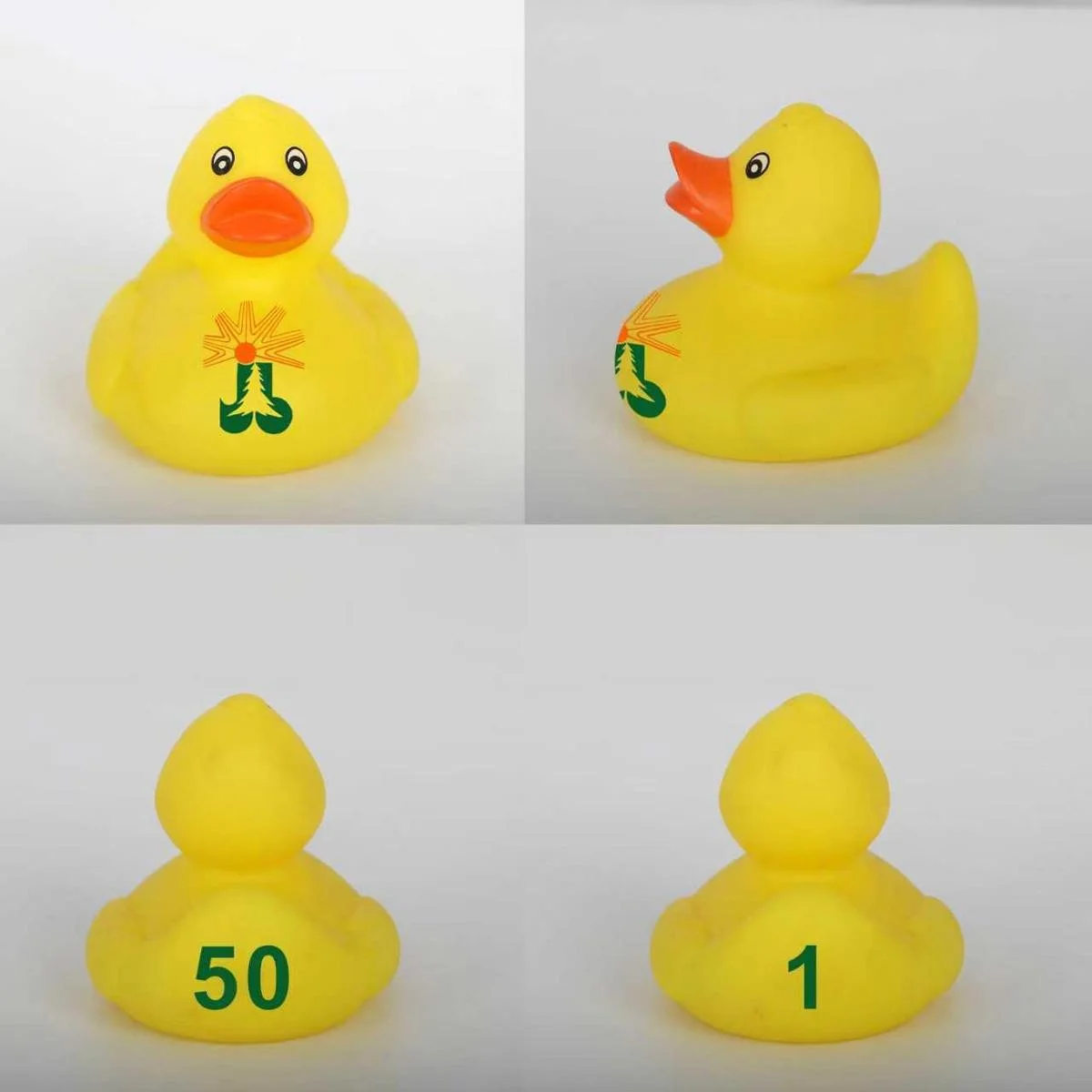
A single-part duck has one surface to check. A two-part duck has the body, the part, the joint and the gap between them, and each one can be wrong while the other three are right. That is a real change in what an inspection has to cover, and it is why an assembled duck asks for more attention than a moulded one even when the parts are simple.
The gap is the one that gets missed. A joint that is mechanically sound can still show a line of daylight, and a line of daylight on a duck that is supposed to look like one object is a visible defect. The check is a look at the assembled duck from the distance a customer uses, not a bench measurement.
The facial detail note is the companion for the small features, because eyes and beaks are usually where a second part or an insert appears, and they are also where a small-part question starts.
The proof is a pull test and a retained first article
The proof for a joint is a pull, done in the direction a person would actually pull, on a part from the production tool. Not a bench sample, not a first shot from a hand tool, and not a photograph of a joint that looks tight.
The second proof is the retained first article. One assembled duck, signed, dated and kept by each side, becomes the reference for the joint, the gap and the bond line. Without it, the second order is judged against a memory of the first, which is exactly how a joint drifts.
The standard a pull is measured against is not a matter of taste either, because a hat or a beak that can be pulled off is exactly the case the small-part rules are written for, and the toy safety testing note sets out what the file has to carry.
What belongs in a multi-part brief

A brief for an assembly is a short document with five sections. The parts list names every piece and whether it is moulded, inserted or bought. The material per part names the compound and the colour route. The joint section names the family, the overlap and what has to survive handling. The tolerance section gives the band at the joint rather than a nominal dimension. The approval section names what the sample has to prove.
That is more paper than a single-shot duck needs, and it is the overhead a second part brings. The accessory note covers the parts themselves, and the mould ownership note covers what happens to two tools over a long run, which is where a fit that was right at the start begins to loosen.
A final check before the tool is cut
Four questions decide whether the brief is ready, and each one has a wrong answer that is easy to miss.
- Which parts are one shot, and which are separate objects?
- Does each part name its own material and its own bonding route?
- What has to survive handling: a decorative hat, or a prop a child will pull?
- Does the approval cover the assembled duck, or only the body?
The stock or custom tooling page is the next decision after this one, and the protective packaging note is where the assembled part has to survive a carton as well as a hand.
Frequently Asked Questions
Does a second material always mean a second mould?
No. Overmoulding puts two materials in one tool with two shots, so the part leaves the machine as one object. A second mould appears when the second material is a separate part that has to be joined, which is an assembly rather than a two-shot moulding.
Which bonding route holds up better?
The one that matches the failure the part will see. A mechanical collar handles a pull better than an adhesive on a small face, and an adhesive handles a flush cosmetic joint better than a collar. The route has to be chosen with the direction of the load, not by habit.
Can a hat moulded for one duck be used on another size?
Only if the collar geometry and the shrink match, which is rare across sizes. A hat is designed around the body it sits on, so a body in a different size band usually needs the hat's seat re-cut rather than a new hat design.
Is an assembled duck still one toy for age grading?
Yes. The object that goes to the child is the assembled duck, so the age grade, the small-part question and the label are decided on the assembly. A safe body with a part that can be pulled off is not a safe toy.
Final Note
Counting the parts before looking at the artwork is the cheapest habit in this trade. A duck with one part has one tool and one set of questions. A duck with three parts has three tools, two joints and a small-part question, and none of that is visible in a picture.
The joint is where a multi-material duck is won or lost, and it is the least expensive thing to change while it is still a drawing. After the tool, it is a new tool.
Key takeaways
- A second material turns a moulding into an assembly, and only the third tier of duck is a real assembly.: This section is covered above.
- Each added part brings its own material, tool, tolerance and failure mode, and the tier table shows which rows stop being moulding questions.: This section is covered above.
- A joint has to be written like a dimension: which surface, how much overlap, what holds it, and what has to be true after handling.: This section is covered above.
- Overmoulding bonds two materials in one tool, while assembly joins two tools and drifts at every join.: This section is covered above.
- Two parts shrink independently, so the fit is controlled by a tolerance band approved on parts from both tools.: This section is covered above.
- Every extra part adds an inspection surface, and the daylight gap at a joint is the one an inspection misses first.: This section is covered above.
- A pull in the direction a person pulls, on a production part, plus a retained first article, is what proves a joint.: This section is covered above.