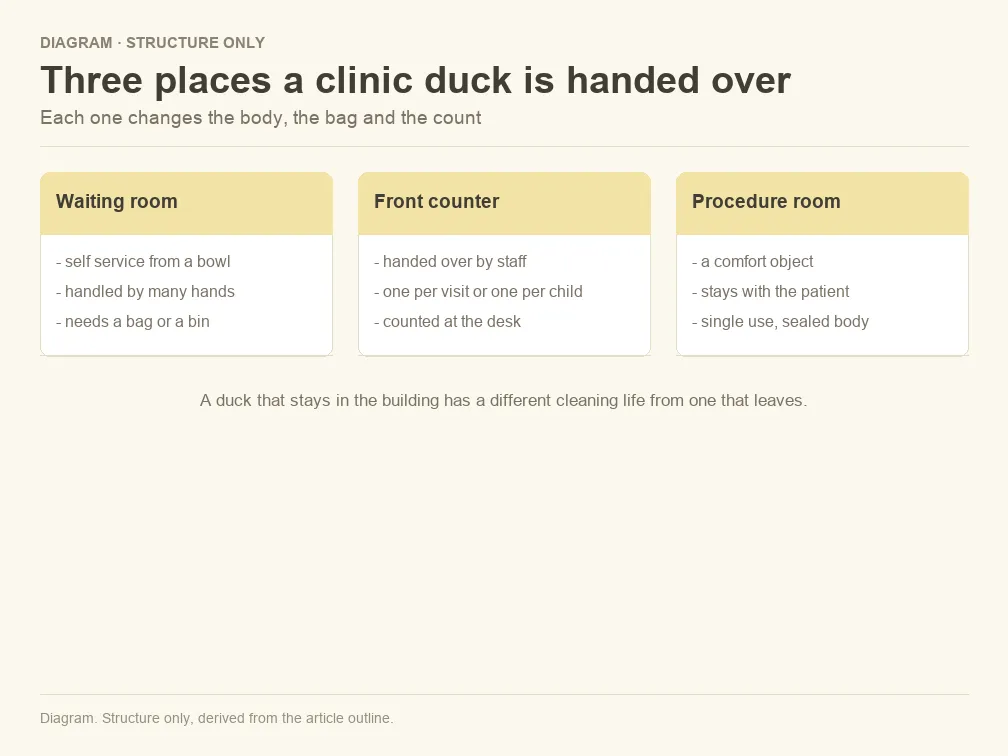
The first question on a healthcare duck is cleaning, because a clinic is the one buyer that has to justify an object staying in the building. A duck handed out at a pharmacy counter goes home and is a small gift. A duck that sits in a waiting room is a shared object, and a shared object is judged by a different standard. That split is what the three touchpoints on this page are built around.
A clinic giveaway answers to cleaning before it answers to marketing.
In short: decide whether the duck leaves with the patient or stays in the room. If it stays, a sealed body with no cavity is far easier to defend than a squeaking duck, because the squeaker is a hole and a cavity and the cavity holds water. Then settle the age question, because a waiting room reaches children, and put the care and age line on the label rather than in a staff briefing.
Why a clinic giveaway is a hygiene question first
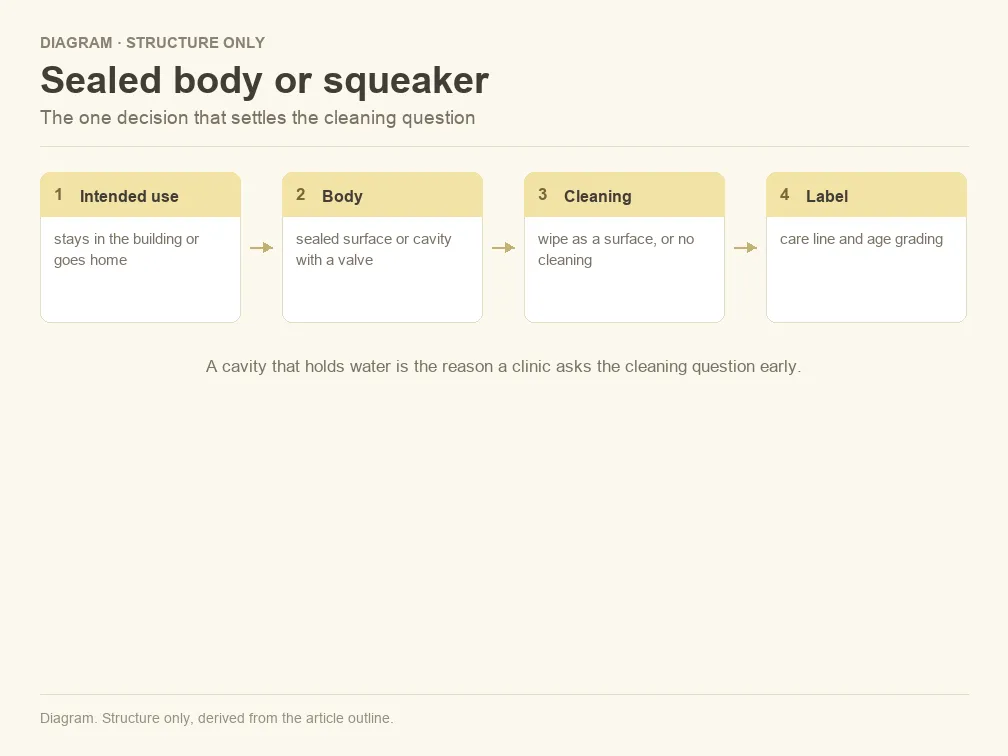
A clinic does not buy ducks as an advertising medium, it buys them as a small comfort and a small brand reminder, and both of those are secondary to the question of whether the object can be kept clean. The moment a duck enters a shared space, someone has to be able to answer how it is cleaned, and a duck that cannot be cleaned has to be treated as single use.
That is a product decision, not a policy one. A sealed body presents a smooth surface that can be wiped. A squeaking duck presents a hole, a valve and a cavity, and water that goes in is hard to dry out, which is why the sealed version exists at all (the cleaning note covers what a washable duck can take).
The useful habit is to write the intended use into the order before the artwork: single patient use, or a reusable item. Everything else, including the bag, the label and the count, follows from that sentence.

Three touchpoints, and what each one needs
A healthcare buyer usually has more than one touchpoint in mind at once, and the three behave differently enough to need separate specifications.
| Touchpoint | Who handles the duck | Does it stay in the building | What the spec needs |
|---|---|---|---|
| Waiting room | Patients, parents, children | Sometimes, on a play table | Sealed body, wipeable, age grading |
| Front counter | Staff, one handover at a time | No, it leaves | Bagged, small, labelled |
| Procedure room | Clinical staff, one patient | No, it goes home with the patient | Sealed body, unbagged or lightly bagged |
Read across the table and the pattern is that the waiting room is the demanding case. The counter and the procedure room are giveaways with a clinical setting, while the waiting room is a shared object with a cleaning regime. A clinic that buys one duck for all three will end up with the wrong object in at least one place.
What the duck has to survive
Three things act on a clinic duck: the wipe, the hand and the bag. The wipe is the obvious one, because a shared object gets cleaned and the print is the part that objects. A print that sits on a high-touch area will wear before the body does, and a body that is smooth and sealed wears more slowly than a body with a moulded seam running through the middle of the decoration.
The hand is less obvious. A duck handled by many people picks up everything that is on their hands, and a light body colour shows it while a mid-tone hides it. That is not an argument for a dark duck, it is an argument for choosing the body colour with the cleaning regime in mind rather than from a brand palette alone.
The bag is the third. A duck that is handed over loose is a duck that gets handled before it reaches the patient, and a duck in a sealed bag is a duck that cannot be checked by the person receiving it. A light bag or a sleeve is usually the compromise for a counter giveaway, while a waiting room duck is better off with no bag at all and a clean surface.
The child in the waiting room
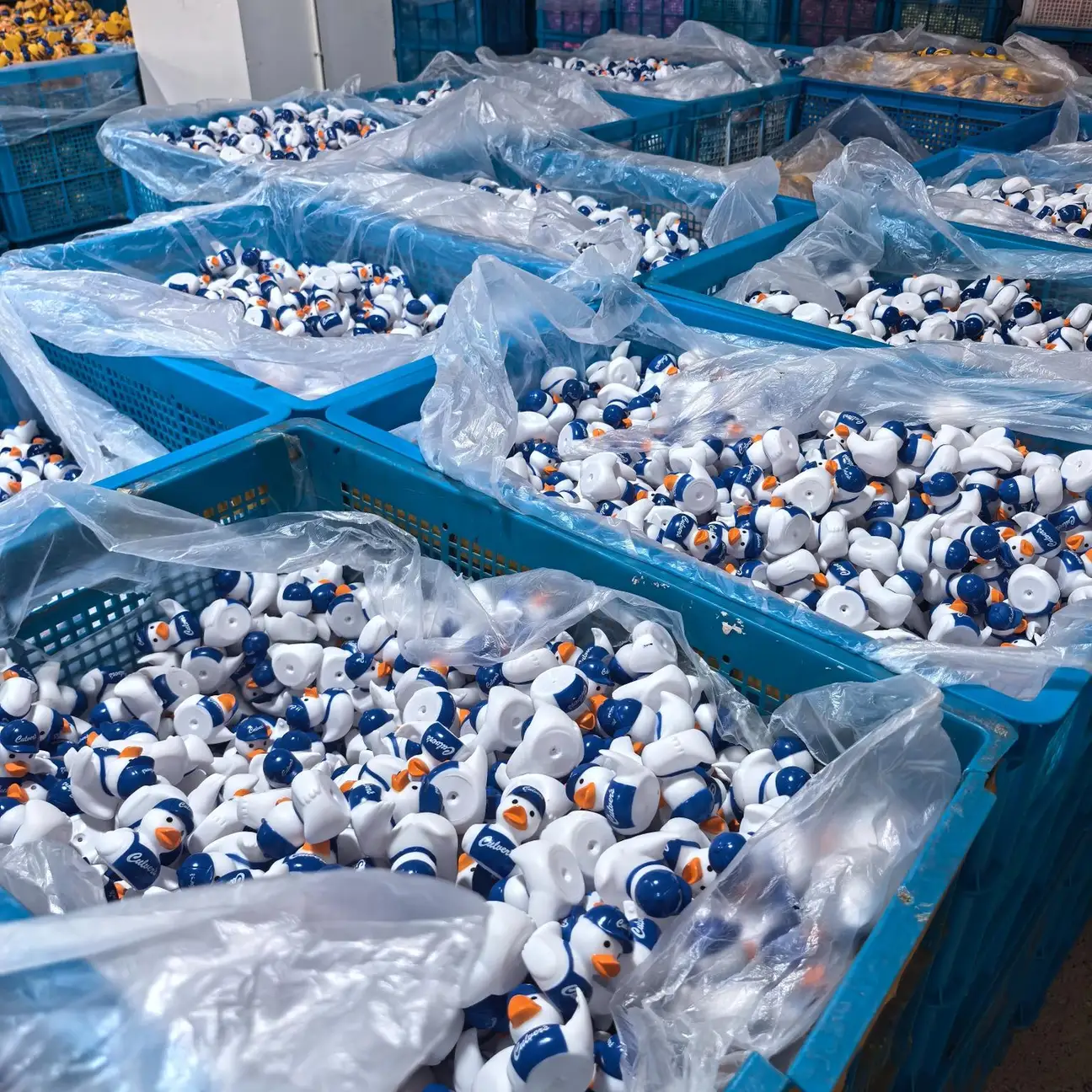
Waiting rooms have children in them, which makes the age question unavoidable. A toy intended for children under three must not be small enough to fit entirely inside the test cylinder, and any part that separates during use and abuse testing is judged by the same rule (16 CFR 1501.4). A small duck with a glued-on hat is exactly the kind of object that rule is written for.
A duck for a child is also a children's product in the United States, which means a certificate that the importer issues rather than the overseas factory (eCFR, 16 CFR Part 1110), and a clinic that hands one out is part of that chain.
The label is where the answer becomes visible. A clinic that hands a duck to a child needs an age grading and a warning that match the product, and the file behind that label is the same one a paediatric ward asks for (the paediatric ward note walks through it, and the label guide covers the wording).
There is a second reason to settle the age question early. A duck that is suitable for a child is a duck a clinic can hand over without a conversation at the desk, and a duck that is not suitable is a duck that has to be kept behind the counter. The specification decides which clinic the buyer is running.
The claim you cannot make
A healthcare setting invites claims, and most of them should be refused. A duck is not a medical device, it does not reduce anxiety in any measurable clinical sense, and it does not sanitise anything. A supplier who writes that a duck is antibacterial or hospital grade is writing a claim that nobody in the chain can support.
The safe version is narrower and more useful: the duck is a comfort item, the body is sealed so it can be wiped as a surface, and the label states the age grading. Those three sentences are enough for a clinic to make its own decision, and they do not require a certificate that does not exist.
The same discipline applies to the imprint. A clinic logo on a duck is fine. A health claim next to a clinic logo on a duck is not, and a marketing team that has spent a year avoiding claims in print will sometimes accept one on a giveaway because nobody reads a duck.
Counting by patients, not by events
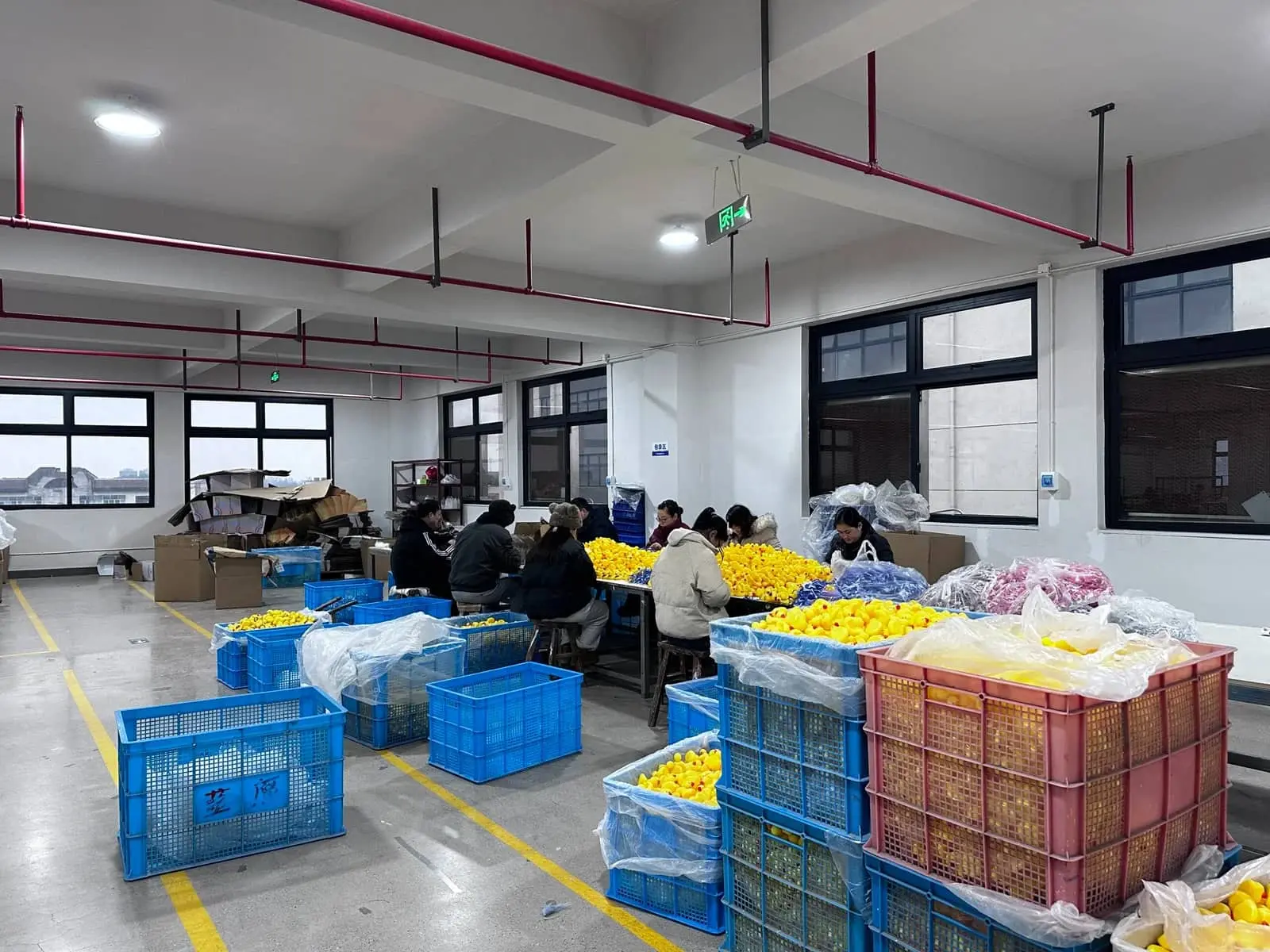
A clinic giveaway is usually estimated from an event, a health fair or a campaign week, and then runs out or piles up. The better starting point is patient volume at the touchpoint: how many visits a week, how many of those get a duck, and how long the campaign runs. That gives a handover count, and the handover count gives the order.
Storage matters as much as count in a clinical setting. A carton that sits in a stock room needs to be clean, dry and off the floor, and the individual bags need to survive being taken in and out of a cupboard. A duck that arrives perfect and waits six months in a damp room is a duck with a problem that the specification never mentioned.
The count also makes the second order possible. A clinic that knows its handover rate can order again without re-running the whole discussion, and the file behind the first order becomes the brief for the second (the branded duck guide covers that file, and the airing note covers what to do if a carton has been closed for a long time).
The five decisions before the first order
- Which touchpoint, and does the duck stay in the building or leave with the patient?
- Sealed body or squeaker, and who answers the cleaning question in writing?
- Which age band, and does the label state it where the patient can read it?
- Which bag, and does the bag help the handover or block it?
- Which count comes from patient volume, and where will the cartons be stored?
Five answers give a clinic a specification it can defend to infection control and a buyer a product that will not be re-specified after the first week.
Final Note
A healthcare duck is a small object in a setting where small objects are scrutinised. The cleaning question, the age question and the claim question each have a defensible answer, and none of them is a marketing decision.
My preference is a sealed duck, plainly marked, labelled for its age band and counted from patient volume. It is a quieter giveaway than a squeaking duck in a display bowl, and it is the one a clinic can keep handing out without a new conversation every year, which in a clinical setting is worth more than a louder object.
Frequently Asked Questions
Can a clinic hand out rubber ducks to patients?
Yes, as a comfort item rather than a medical product. The duck needs an age grading if it may reach children, a label that matches the product, and a body that fits the cleaning regime of the space it is used in.
Is a sealed duck better than a squeaking duck for a waiting room?
For a shared space, yes. A sealed body presents a surface that can be wiped, while a squeaker adds a hole and a cavity that hold water. The squeak is a comfort feature that a clinical setting usually trades away.
Do clinic giveaways need a certificate?
They need the same file any toy needs if the duck is intended for children, which in the United States includes a children's product certificate issued by the importer. They do not need a medical certificate, and a supplier claiming one should be asked for it.
How many ducks should a clinic order?
Count from patient volume at the touchpoint and the length of the campaign, then add a margin for the second room. A handover count is a number a practice manager already has, and it beats an estimate based on how a bowl looks.
Key takeaways
- Why a clinic giveaway is a hygiene question first: the cleaning answer decides the body.
- Three touchpoints, and what each one needs: the waiting room is the demanding case.
- What the duck has to survive: the wipe, the hand and the bag.
- The child in the waiting room: the age question is unavoidable in a shared space.
- The claim you cannot make: a duck is a comfort item, not a medical device.