Career ducks are tooling decisions wearing uniforms, and the outfit route decides what the body has to become. Moulded detail, a printed costume and an accessory each change the tool in a different way.
The uniform can be moulded, printed or attached, and each route changes the tool.
In short: a career duck is built by one of three routes, a moulded prop that is part of the tool, a separate part that is fixed on afterwards, or print only. The first two change the tool and create a parts question, the third does not. Decide which one you are buying before the artwork, because the route also decides the age grading, the pull check and what a repeat order has to reproduce.
Why the career duck arrived and stayed
Occupational merchandise works because a profession is an identity that people are willing to wear in small doses. A nurse, a teacher, a firefighter or a mechanic will keep an object that says this is what I do, in a way that nobody keeps a generic logo. The duck is a good carrier because it is modest to make, hard to throw away and legible at a glance, and the outfit does the work that a logo cannot.
The boom also has a practical cause, which is that an outfit is a less expensive way to make a new product than a new shape. A new body needs a new tool. A hat, a helmet, a stethoscope or a printed uniform can often be added to an existing body, which is why the category exploded: the same duck appears in twenty professions without twenty new bodies.
That is also where the difficulty starts. The less expensive route to a new product is the route with more small parts, and small parts are exactly what a toy for children is judged on.
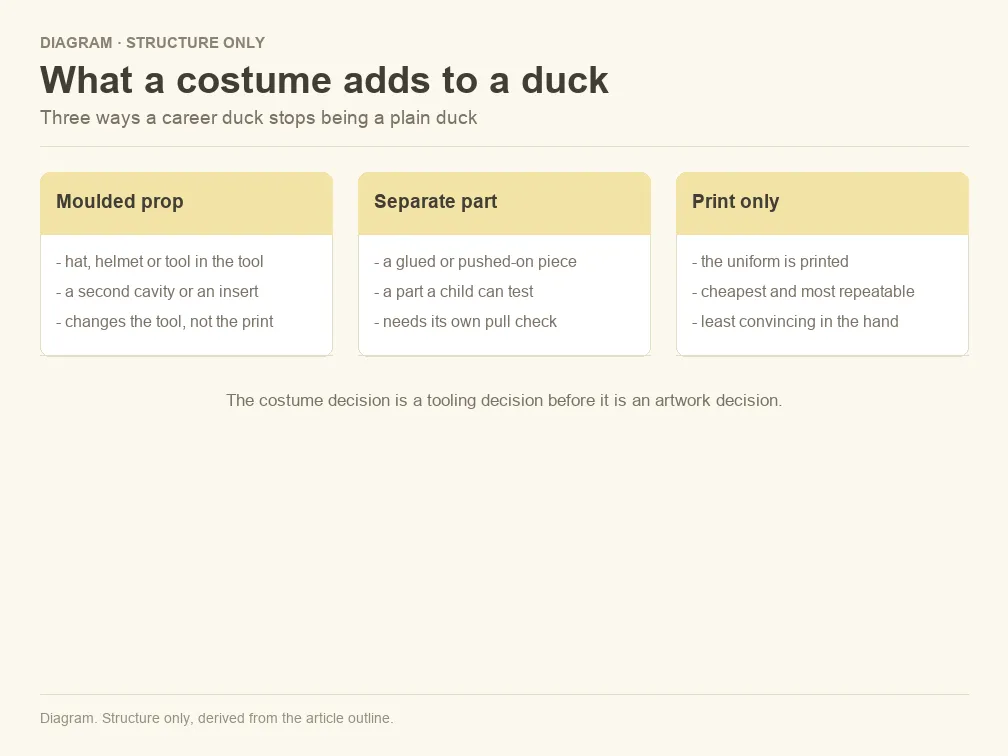
Three routes to an outfit
The first route moulds the prop into the tool. The hat or helmet is part of the cavity, the duck comes out in one piece, and there is nothing to attach. It is the cleanest answer for a child's product and the most expensive one to change, since every design change is a tool change.
The second route fixes a separate part onto a standard body: a hat that pushes onto the head, a tool that glues to a wing, a badge that clips on. It is the fastest way to build a profession range, and it creates a parts question for every item. The third route prints the uniform onto the body, which is the most repeatable and the least convincing in the hand, because a printed stethoscope does not read as an object.
| Route | What it changes | What it gives | What it asks of you later |
|---|---|---|---|
| Moulded prop | The tool | One-piece duck, no parts question | Every revision is a tool revision |
| Separate part | The assembly step | A fast profession range | A pull and a parts question per item |
| Print only | The artwork | Fastest and most repeatable | Reads as a picture, not an object |
None of the three is wrong. A promotional order for adults can use a separate part and never see a child. A children's product should be moulded in or printed, and the extra tooling work is the bill for a product that does not need a warning to explain itself.
What an outfit does to the tool
A moulded prop is a change to the cavity, and a cavity change is not a small edit. Adding a hard hat means deciding where the tool splits, how the hat fills, how the part is ejected and whether the hat needs its own cooling. A hat that is under-cut cannot be pulled from the tool without a slide, and a slide is a tool feature that has to be paid for in the steel.
The tool also decides the seam. A duck with a prop has a parting line that has to run somewhere, and a line that runs across the face of a stethoscope or the brim of a cap will show on every unit. That is the kind of problem that is easy to fix on a drawing and expensive to fix after the steel is cut (how the tool is cut and what the drawing fixes goes through that stage).
A separate part has its own tool, often a small one, and its own tolerance. The part has to fit the body it is designed for, which means an outfit piece is tied to a specific body and cannot be swapped between shapes without a check.
The parts question a career duck creates
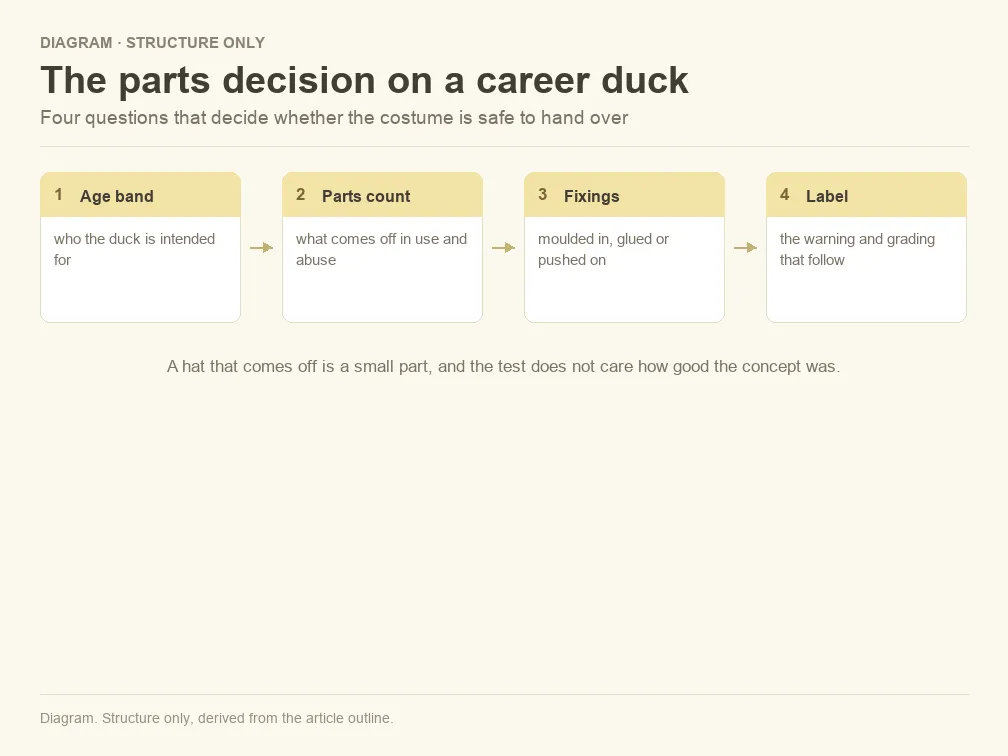
Every separate part on a duck is a part a child can test. In the United States, a toy intended for children under three must not be small enough to fit entirely inside the test cylinder, and a part that comes off during use and abuse testing is judged by the same rule (16 CFR 1501.4). A hat, a badge or a tool that separates under a pull is a small part, regardless of how well the concept worked on the mood board.
The fixings matter as much as the shape. A part that is moulded into the body cannot come off. A part that is glued can come off if the glue is wrong or the surface is contaminated, and a part that is pushed on relies on the interference fit staying tight through temperature changes and handling. Each fixing has a different failure mode, and the failure mode is what the pull check is designed to find (how accessories and props are moulded in covers the routes).
In the European Union a duck sold as a toy also falls under Directive 2009/48/EC, which puts the safety assessment and the technical documentation on the manufacturer before the toy is placed on the market (European Commission, placing toys on the EU market).
The age question then decides the label. A duck built for adults can carry a separate part with a warning, while a duck built for children needs a design that survives the test, and the difference is a decision taken before the tool is cut rather than after the first batch fails.
Making a profession range repeatable
The reason a career range is attractive is also the reason it drifts. Twenty professions built from one body and twenty separate parts means twenty part numbers, twenty fixings and twenty chances for the second batch to use the wrong one. A range that is specified as a family, with one body and a table of parts, is a range that can be reordered.
The table is short and specific: the profession, the body it fits, the part number, the fixing method, the part's own colour and the label that goes with it. A plain duck range reordered from the same body is covered in the custom duck note. A buyer who holds that table can order the nurse and the firefighter separately without accidentally ordering the nurse's hat with the firefighter's body.
Print-only professions belong in the same table with a different note, because they share the body but not the tooling. Mixing the two routes in one range is fine, as long as the table says which is which.
Packing a range and counting it
A career range creates a packing problem that a single duck does not. A trade buyer may want a mixed carton of six professions, a hospital may want one profession only, and a gift shop may want a display of the full set. The carton count has to be specified per profession and per mix, or the picker builds the mix from memory.
The packaging decision follows the selling channel rather than the duck. A mixed carton with a display header suits a gift shop, a single-profession carton suits a hospital or a professional association, and a loose bag suits a giveaway. The hang tag note covers the small printed piece that often carries the profession name, and the branded duck guide covers the file behind a branded range.
Counting a range is also harder than counting one duck, because a best-selling profession will run out first. That is worth knowing: if the range is sold as a set, the set is only complete while the least popular profession is still on the shelf.
The five decisions before the first order
- Which route, moulded prop, separate part or print only, and does the tool already exist?
- Which age band, and does the route survive the parts rule at that age?
- Which fixing, and what does the pull check have to prove?
- Which table lists the professions, bodies, part numbers and labels?
- Which packing, per profession and per mixed carton?
Five answers make a career range a product line rather than a set of one-off orders, and they are the five questions a repeat order will ask again anyway.
Final Note
The occupational duck is a good idea with a tooling bill attached, and the bill is largest exactly where the product is most convincing. A moulded hard hat is a better object than a printed one and a harder thing to change.
My preference is a small range built on one body, with the profession carried by a moulded or printed feature rather than by a glued part, and a table that makes the range reorderable. The duck in uniform is charming. The table is what keeps the range on the shelf.
Frequently Asked Questions
What is an occupational duck?
A rubber duck made to represent a profession, usually through a moulded hat or tool, an attached part or a printed uniform. The category covers nurses, teachers, firefighters, chefs, construction workers and dozens more.
Are career ducks safe for children?
They can be, if the outfit is designed for the age band. A separate part such as a hat or a badge has to pass the small parts rule for the youngest user, which is easier to satisfy with a moulded or printed outfit than with a glued part.
Why do career ducks carry a higher tooling bill than plain ducks?
Because an outfit usually changes the tool, and a tool change is the expensive part of any duck. A printed uniform avoids the tool change and is the least expensive route, while a moulded prop is the most expensive and the most durable.
Can one body be used for several professions?
Yes, and that is the usual way a range is built. One body plus a table of parts and prints keeps the range coherent, and the table is also what makes a reorder possible without rebuilding the whole range.
Key takeaways
- Why the career duck arrived and stayed: an outfit makes a new product without a new body.
- Three routes to an outfit: moulded, attached or printed, with different consequences.
- What an outfit does to the tool: a prop changes the cavity, the seam and the slide.
- The parts question a career duck creates: a hat that comes off is a small part.
- Making a profession range repeatable: one table, one body, many professions.