Float problems are construction problems, because a duck that tips is a body with its mass in the wrong place or a shell that no longer holds the air it was given. The shape is rarely the cause. The order I work in is the air, then the mass, then the water, because each one changes what the next can do.
A duck floats on air rather than on plastic, and the mass is what decides whether it sits level.
In short: A duck floats because air trapped inside the body pushes water away, and it sits upright because its mass is arranged low and central. Three things decide whether it does that: how much air the shell holds and whether the shell stays sealed, where the heavy parts sit relative to the waterline, and how wide the base is at the surface. Balance is designed into the base and the wall, and it is proved by a water test, not by a drawing.
A Duck Floats on Air, Not on Plastic
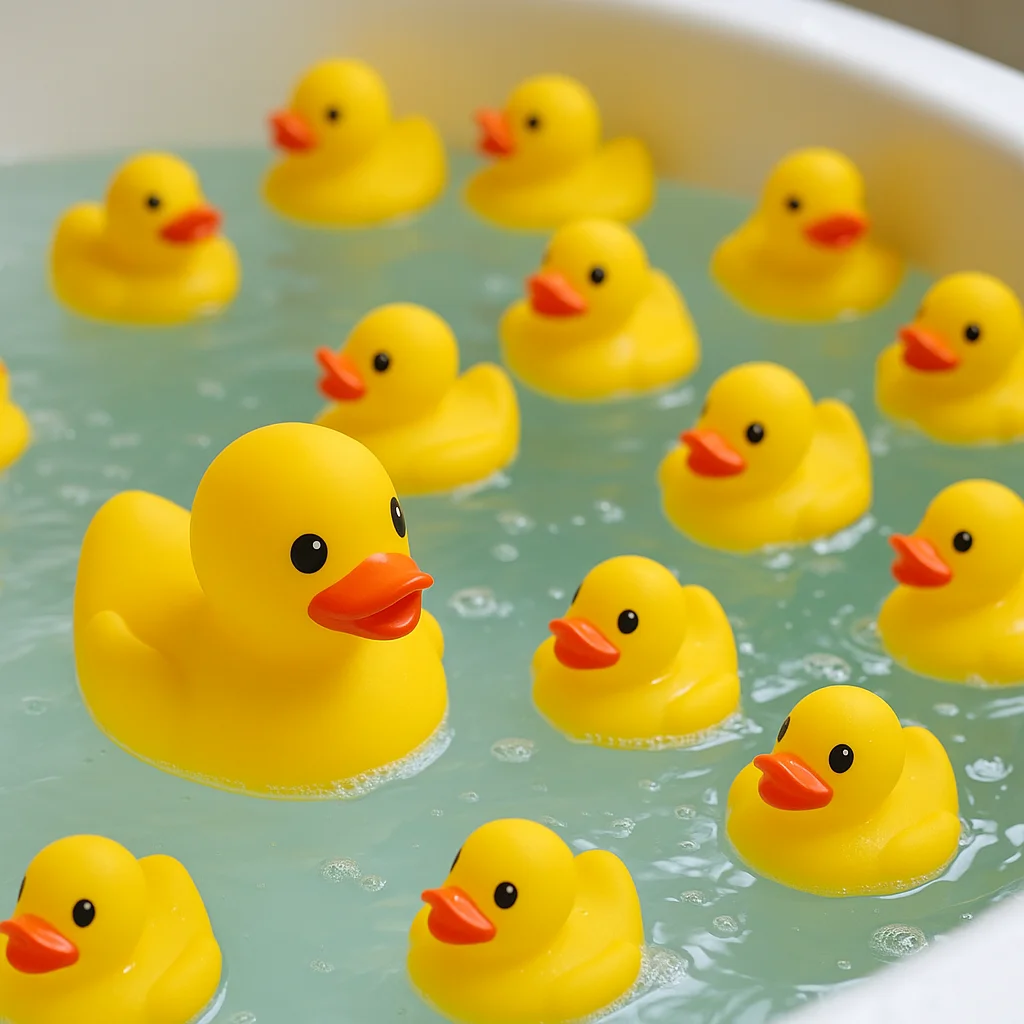
The material of a duck tells you how it feels and how it wears. It does not tell you whether it floats, because the body is mostly air. A hollow shell that holds its air displaces enough water to carry its own mass, and the duck sits at a waterline set by that balance. A solid body has to displace water with material alone, which is why a solid duck either needs to be large or needs a designed cavity.
That is the first distinction to make in any float conversation, because the two bodies fail differently. A hollow duck fails when the air escapes or when the mass shifts. A solid duck fails when the design gives it nothing to float with, and no amount of base shaping will fix a body that is denser than the water it sits in.
The shell has to stay sealed, and that is a durability question before it is a float question. A toy that is dropped and pulled is a toy whose shell is being tested, and the use and abuse sequence in 16 CFR 1500.52 describes the drop and the grip that a small toy is expected to survive. A crack at the tail or a loose filling plug turns a floating duck into a sinking one without changing a single drawing.
Three Things Decide Whether It Sits Upright
Floating and floating upright are two different results. The first needs enough displaced water. The second needs the centre of mass to sit below the centre of the displaced volume, and the base to be wide enough to resist a nudge.
Air volume sets how high the duck rides. A body with more air sits higher and becomes easier to tip, because the same mass is now supported by a smaller share of the body being under water. Mass placement sets the angle: a duck whose heavy parts sit low returns upright after a push, and a duck whose weight sits high rolls over and stays there. Base width sets how much push it takes to start that roll.
The three interact, which is why a change made for one reason breaks another. A taller hat adds mass high up and lifts the profile, so a duck that floated level with a bare head can lean once the character is complete. A wider base adds stability but also adds material at the bottom, which changes the waterline. None of these is a defect; each is a line that has to be decided together.
| What moves | What it does to the float | Where it is checked |
|---|---|---|
| Air volume in the shell | Sets how high the duck rides and how easily it tips | Waterline on a still surface |
| Mass at the base | Pulls the duck back upright after a nudge | A push and release, watched for return |
| Mass above the waterline | Raises the centre and lengthens the roll | The angle after a tilt |
| Base width at the surface | Sets how much push starts a roll | A sideways nudge at the head |
| A vent or open hole | Lets air out and water in over time | A soak, then a second float |
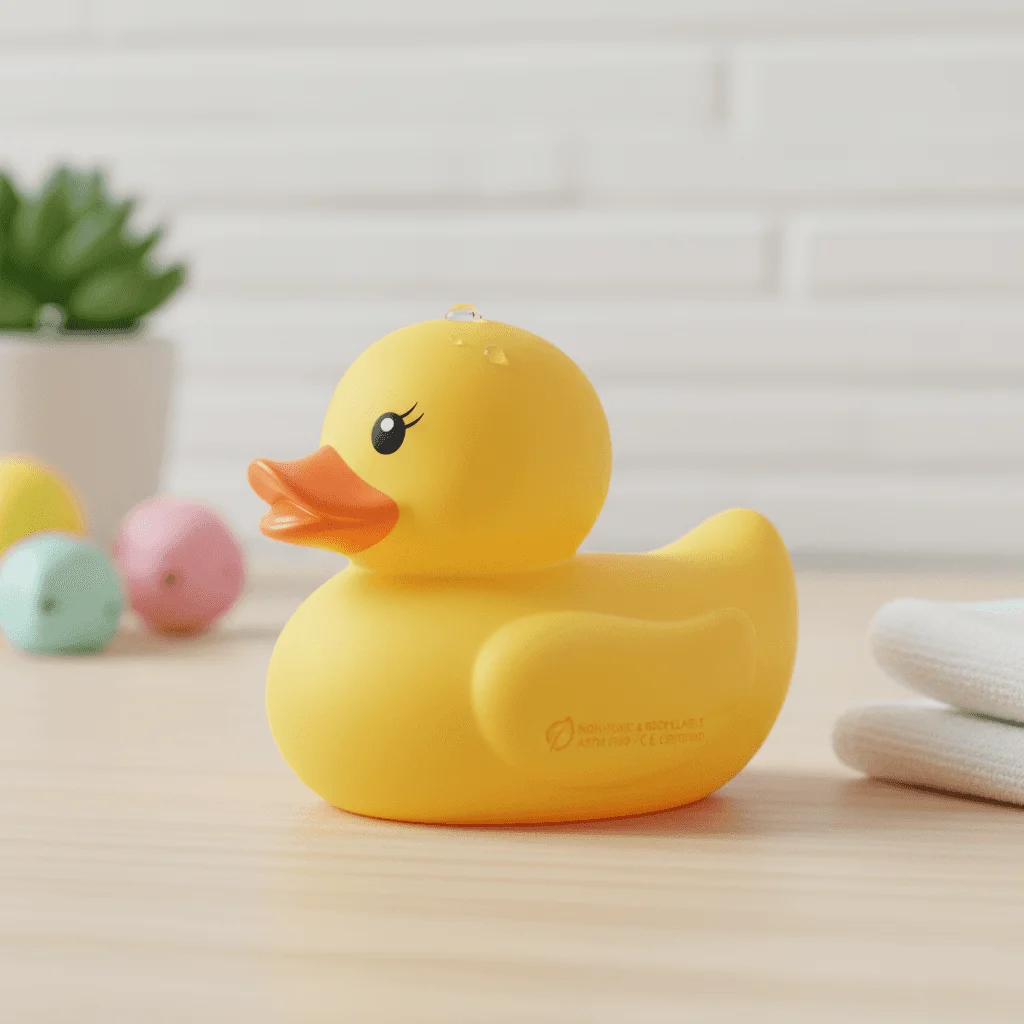
Where the Mass Goes
Most balance corrections are made at the base, because that is where mass can be added without changing the silhouette. A weighted base, a thicker floor, or a small insert at the tail all move the centre of mass down, and a duck that was unstable becomes stable without any change above the waterline.
The direction of the correction depends on the failure. A duck that leans forward usually has too much mass at the head end, or a beak that is heavier than it looks once it is painted. A duck that leans to one side often has an uneven wall or a part fitted off centre. A duck that floats but rolls easily is not heavy enough at the bottom, even if its total mass is right.
Base design is the part a buyer can influence earliest, because it is a drawing change rather than a body change. The base designs page covers the flat, weighted and suction options, and the choice between them is really a question about the water the duck will sit in.
What the drawing needs is a target, not a preference. A line that says the duck must return upright after a sideways push is a requirement. A line that says the duck should float nicely is not, and it will be read differently by every person who tests it.
The Vent, the Squeaker and the Sealed Shell
A squeeze duck needs a way for air to move, and that path is also a way for water to get in. The squeaker sits in the air path, and the vent that lets the sound out is the same opening that lets a bath fill the shell if the part or its seating is wrong.
That is why a float test has to be run with the part fitted and the vent in place, on a unit from the bulk run rather than the prototype. A shell that is sealed at the tool but open at the assembly step will pass on the bench and fail in the bath, and the failure appears slowly, as water works past the vent and the duck sits lower each time.
The sealed shell is also the condition that makes the whole float predictable. Once air can escape, the duck's mass changes with every soak and the balance measurement stops meaning anything. This is the point where a float problem and a quality problem become the same problem, and the squeaker page covers how the part and its seat are designed.

What the Waterline Tells You on a Sample
A float check takes minutes and it answers more than a measurement. Fill a clear container deep enough that the duck is not touching the bottom, let the water settle, place the duck gently, and watch three things: where the waterline lands, how long the duck keeps moving, and what it does after a nudge.
A duck that is still moving after a long settle has air moving inside it, which usually means the shell is not sealed or the wall is flexing more than the design assumed. A duck that sits level but rolls over from a light push has its mass too high or its base too narrow. A duck that floats with one side low has an asymmetry, and that is a tool or an assembly question rather than a water question.
Then push it and let go. A stable duck rocks a few times and returns to its trim. An unstable one keeps rolling, or comes back at a different angle, and that second behaviour is the one that turns into a complaint, because it does not look broken, it looks wrong.
Repeat the check on a second unit. One duck shows what the design can do; two ducks show whether the run does it the same way twice, which is the question a buyer is really asking when they say the sample floated and the delivery did not.

Which Use Makes Balance Hardest
Balance is not one requirement. A desk duck needs a flat base and no water at all. A bath duck needs to sit upright in a shallow tub and survive being squeezed, dropped and refilled. A pool or pond duck needs to handle a surface that moves and a depth that hides the base.
Four questions settle it before a sample is requested, and each one is worth an answer in writing:
- Which base does the use call for, flat, weighted or suction, and does the water in the test match the water in the real setting?
- Where is the mass, and was the wall measured on pieces from the bulk run rather than on the prototype?
- Does the duck have a vent, and was the float test run with the vent in place?
- What is the pass definition: depth, settle time, a nudge and an angle?
Each use moves the tolerance. A bath duck can be corrected with a weighted base because the water is still. A duck used on moving water needs more stability and a wider footprint, and it needs the balance to hold when the water is not level, which is a harder drawing than a tub.
The label matters here as well. The CPSC toy safety guidance explains that ASTM F963 is the mandatory toy standard under 16 CFR part 1250, and its labeling requirements name aquatic toys specifically, which means a duck sold for water carries a labeling question alongside the balance question. Read the CPSC toy safety guidance before a water use is added to a duck that was designed for a shelf.
The float testing page covers the procedure in more detail. The point to carry into the spec is that the use decides the test, and a test written for a desk will not catch a problem that only appears in a bath.

Write the Requirement as a Test
A float requirement that can be argued with is a requirement written as a test. It names the container, the water, the depth, the settle time, the nudge, the angle and the pass definition, and it is short enough that two people can run it the same way.
Four lines do most of the work. The duck must float with its beak above the waterline at rest. It must return to within a stated angle after a sideways push at the head. It must stay within that angle after a stated settle in water. And it must still do both after the squeeze and drop that the use implies.
The value of writing it down is that it separates a design conversation from a quality conversation. If the duck fails the written test, the drawing or the assembly is wrong. If it passes the test and the buyer dislikes the trim, that is a drawing preference, and it does not require a tool change to discuss.
What to Fix at the Tool
Three corrections belong at the tool, and they are worth naming because each one is simpler to do once.
The first is the base: a thicker floor or a designed pocket for mass, placed where it pulls the centre down without changing the waterline much. The second is the wall, because an uneven wall changes the mass distribution around the body and is invisible on a drawing. The third is the vent and part seating, because an air path that is not deliberately designed is an air leak that is designed by accident.
The wall thickness page covers how the wall is specified, and the accessories page covers what a hat or a prop adds above the waterline. Both belong in the balance conversation before the cavity is cut.
Everything else is a sample conversation. Paint mass, a fitted part, the exact water used in the test: those can be settled on the bench, and none of them needs the tool to be open.
Frequently Asked Questions
Why does my duck tip over?
Usually because the mass is too high or the base is too narrow for the body's air volume. A duck that carries a hat, a heavy beak or a part fitted off centre will roll more easily than the same body without them, and the correction belongs at the base rather than at the top.
Why did the sample float when the bulk does not?
Because the sample and the bulk can differ in wall, in part seating or in sealing, and each of those changes the mass or the air. A float test on a prototype proves the drawing, not the run, so the check has to be repeated on units taken from the delivery.
Do drain holes make a duck tip?
A hole changes the air path, and the air path is what float depends on. A drain hole that lets water into the shell adds mass low down and can make a duck sit lower, and a hole that lets air out steadily makes the trim change with every soak. Either way the hole belongs in the float test rather than outside it.
How do I write a float requirement?
Write it as a test with a container, a water level, a settle time, a nudge, an angle and a pass definition, then run it on bulk units with the vent and the part fitted. A requirement that cannot be repeated by two people is not a requirement, it is a preference.
Final Note: Five Lines Before the Float Is Signed Off
- State whether the body is hollow or solid, because the two fail in different ways.
- Name the base and where the mass sits, and check the correction on a bulk unit.
- Confirm the shell is sealed with the part fitted and the vent in place.
- Write the float as a test with a container, a settle time, a nudge and an angle.
- Run the test twice, on two units, before the delivery is accepted.
A duck that floats is easy. A duck that floats the same way on the tenth unit as it did on the first is the product, and the difference between the two is a drawing line and a bucket of water.
Key takeaways
- A duck floats on trapped air, so the shell and its seal decide the float before the material does, covered under a duck floats on air.
- Air volume, mass placement and base width decide whether it sits upright, and changing one moves the others, covered under three things decide.
- Balance corrections belong at the base, where mass can move without changing the silhouette, covered under where the mass goes.
- The vent and the squeaker are part of the air path, so a float test without the part fitted proves nothing, covered under the vent and the sealed shell.
- Write the requirement as a test with a container, a settle time, a nudge and an angle, covered under write the requirement.