Separate the pigment from the vinyl when a dashboard duck fades, because the two layers fail at different rates. The pattern of the change says which layer went first, and that answer belongs on the spec sheet.
A faded dashboard duck is evidence of which layer failed, not a complaint about the colour.
In short: a jeep duck dash fade is a specification problem before it is a defect. The pigment in the compound, the print on top of it and the finish over both age at different rates, so the sheet has to name all three and the check has to separate light from heat. A duck that was specified only as UV stabilised has been labelled, not specified.
Why a dashboard is the hardest place a duck lives
A dashboard is not a shelf. It is a small, hot, bright platform behind glass, and the duck that sits on it is asked to hold a colour and a print through a whole summer of that. The surface reaches a higher temperature than the air in the cabin, the light arrives for hours rather than minutes, and the duck is small enough that the whole of it is exposed rather than one face.
The same duck is also handled. It is picked up by a child, dropped in a footwell, wiped with a cloth and occasionally left in a cup holder where the sun finds it from a different angle. A fade that appears on one side and not the other is usually a placement result rather than a batch result, which is why the first question about a faded duck is where it sat, not who made it.
That combination is what makes the dashboard the hardest duty in the whole jeep duck category. A duck that survives a shelf, a bag and a club meet can still change on a dash, because the dash is the only place where light, heat and time all arrive together. The jeep duck note covers what the category is bought for, and the set note covers how it is packed for a season.
What fades first, and in what order
| Layer | What changes | How it reads on the duck | What holds it back |
|---|---|---|---|
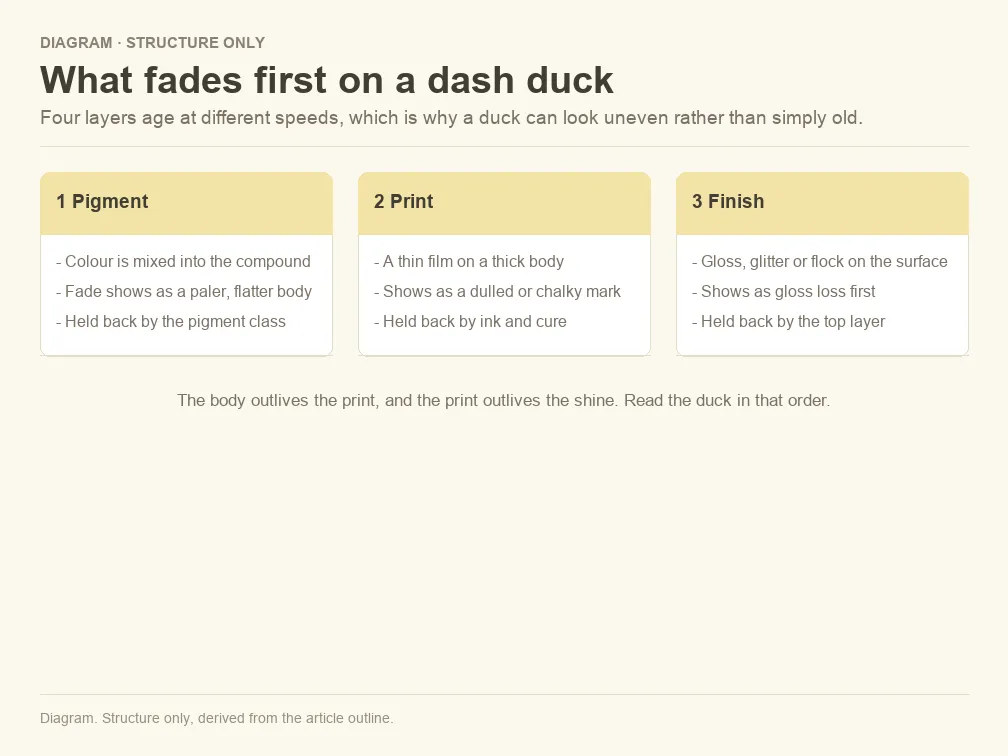
| Pigment in the compound | The body colour moves toward a paler, flatter tone | The whole duck looks washed, including the base | Pigment class and the stabiliser package |
| Pad print | Ink film dulls, chalky edges, small gaps | The mark loses contrast before it loses shape | Ink type, cure and adhesion |
| UV print | A thinner film that can wear and fade faster | Fine detail disappears first, then the field | Ink laydown, cure and the top layer |
| Finish | Gloss drops, glitter dulls, flock goes flat | The duck looks older than its body colour says | The top coat or the finish process |
| Vinyl itself | Plasticiser migrates, the body stiffens | The duck feels different before it looks different | Compound and storage |
Read the table from the top down and the practical rule is that the body outlives the print, and the print outlives the shine. That order matters when a buyer inspects a batch, because the first thing to check is not the body colour but the edge of the mark and the reflection on the head.
Light and heat are two stressors, not one
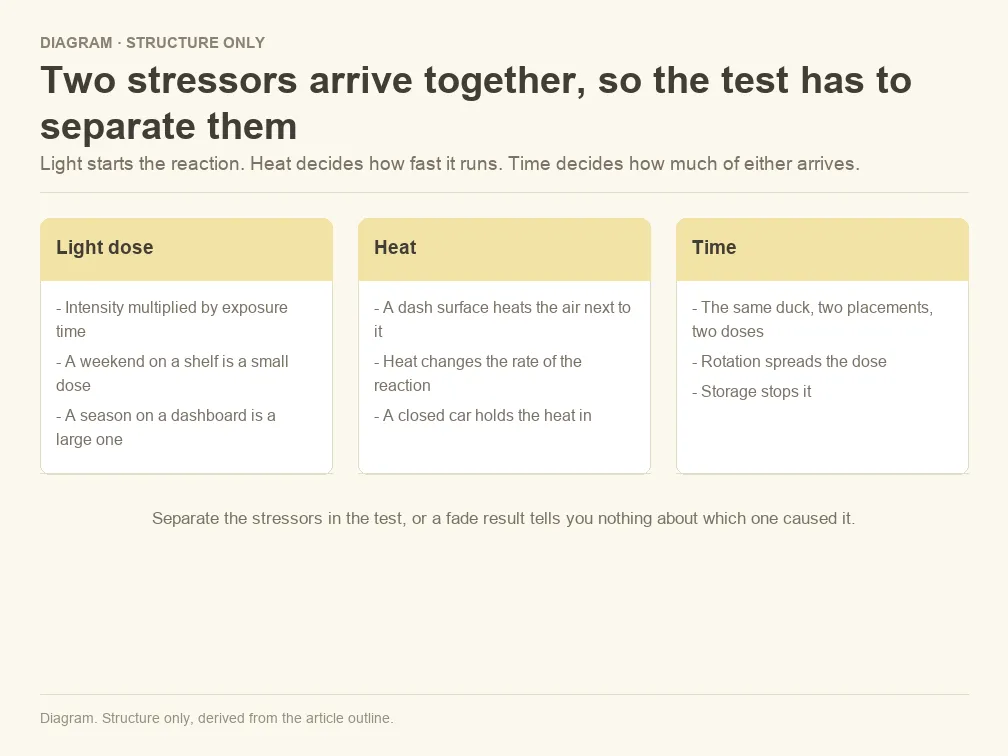
Light and heat are usually discussed as one problem, and they are two. Light starts the chemistry that changes a pigment or an ink. Heat changes how fast that chemistry runs. A duck that has been in a hot car for a month with the windows up has received a different treatment from a duck that spent the same month in a shaded garage, even if the light dose looks similar on paper.
The heat half is measurable in the cabin rather than in the sun. The National Weather Service describes a parked vehicle the same way: objects such as the dashboard heat the air next to them by conduction and convection and also radiate it back, which is why the inside of a closed car can move from a safe temperature to an unsafe one in a couple of minutes (National Weather Service, children, pets and vehicles). A duck bonded to that surface is living in the hottest air in the car.
The light half is a dose, which is intensity multiplied by time. A display duck that sits out for a weekend collects a small dose, and a dash duck that sits out from May to September collects a large one, even though both are described as being in the sun. The two stressors then compound, because the heat accelerates the reaction that the light started, and the duck that looks worst is usually the one with both the highest dose and the hottest parking spot.
Colour lives in the compound
A body that fades is a compound problem, not a surface problem. Colour is mixed into the vinyl before the duck is moulded, so a pale body cannot be corrected by polishing or by a coating. The only levers are the pigment class and the stabiliser package that go into the mix before moulding.
A useful reference for how much those levers matter is the accelerated weathering work published by NIST, which exposed pigmented engineering plastics to controlled ultraviolet light and measured yellowing and gloss loss against irradiance, temperature, humidity and wavelength. In that work, doubling the irradiance doubled the rate of degradation, and the activation energy for yellowing was quantified for each material, which is a formal way of saying that temperature changes the rate and not only the light dose (NIST, accelerated weathering parameters).
That result is why a compound conversation should be about the pigment and the stabiliser together. A strong pigment with no stabiliser will still move under a hard dose, and a stabiliser package that is not matched to the pigment buys less than its label suggests. The stabiliser note covers the additive side, and the colour note covers how a colour reference is agreed before moulding.
The UV package and the line that specifies it
Most spec sheets say UV stabilised and stop there. That phrase describes an intention rather than a performance, because it does not name the stabiliser, the loading, the pigment it has to protect or the test that was run. Two ducks from two suppliers can both be UV stabilised and behave very differently on the same dashboard.
A line that can be checked names four things: the compound family, the pigment class, the stabiliser type with its loading, and the weathering test the batch was judged against. The test matters as much as the additive, because an accelerated test with a stated irradiance and a stated temperature can be repeated, and an unstated one cannot. A supplier who can name the test can usually also explain what failed in the last one.
For a buyer, the practical move is to ask for the compound line and the test line on the same document, and to keep both with the batch file. That document is what turns a fade conversation from an opinion into a comparison, and it is also what makes the second season easier to specify than the first. The print method note covers the layer that sits on top of that compound.
The finish decides how much you see
Two ducks can lose the same amount of colour and look completely different, because the finish controls how the change is read. A gloss body shows gloss loss first, and a dull patch on a shiny head is visible from a metre away. A matte or flocked body hides the shine change and then shows a chalky bloom instead, which reads as dirt rather than as fade.
Glitter and metallic finishes are the most exposed because they depend on a surface effect rather than on pigment alone. The glitter that gives the duck its sparkle is a flake in a binder, and when the binder dulls the sparkle goes with it, even if the colour underneath has barely moved. That is why a glitter duck often looks old before a plain duck of the same age does.
The finish is also the layer a buyer can change most easily, because it does not touch the tool. If the duty is a dashboard, a plainer finish with a stronger top layer is usually a better answer than a more decorative one, and it keeps the replacement decision simple. The flocked finish note covers the fuzzy route, and the hardness note covers how the body itself is specified.
Print fades before the body does
The print is a thin film on a thick body, so it has less material to lose and it sits where the light lands first. A mark that has faded to a pale version of itself is doing what a thin film does, and the useful question is whether it faded faster than the specification allowed rather than whether it faded at all.
A logo that rubs off usually has one of two causes: mold release agent left on the surface, which stops the pad print bonding to the duck body, or an ink that is not right for the job. We test adhesion by pressing tape onto the logo and peeling it back slowly, then wiping the area with a wet tissue for about 30 seconds to see whether the colour shifts.
Adhesion and cure decide most of that. An ink that has not cured fully will lose its edge before it loses its colour, and a mark on a curved flank will thin at the edge of the pad contact. That is why a four view proof and a cured sample matter more than a colour chip, because they show the film where it is thinnest rather than where it is easiest to print.
There is also a compliance line that does not move when the print is reformulated. Paint and similar surface coatings on a product for children are limited in lead content, and the current limit is 0.009 per cent of the weight of the dried film (16 CFR 1303.1). A new ink chosen for fade resistance still has to clear that line, which is a reason to ask for the coating documentation with the print proof rather than after the batch. The logo fade note covers the adhesion side in more detail.
Placement and rotation are two free fixes
The least expensive change a buyer can make is where the duck sits. A duck placed against the glass collects more light and more heat than one placed in the shadow of the mirror or on the shaded side of the dash, and the difference over a season is larger than most buyers expect. Moving the duck is free and it changes the dose.
Rotation is the second free fix. Turning the duck so a different face meets the light spreads the dose across the body instead of concentrating it on one side, and it also spreads the print wear. A club that tells its members to rotate the duck once a month is running a maintenance instruction rather than a quality fix, and it is the simplest instruction in the whole programme.
Storage is the third. A duck kept in a glovebox, a bag or a box between seasons collects almost no dose, which is why a stored duck and a displayed duck of the same age can look like different products. The storage note covers shelf life and how a stored duck should be kept.
Testing a batch without a lab
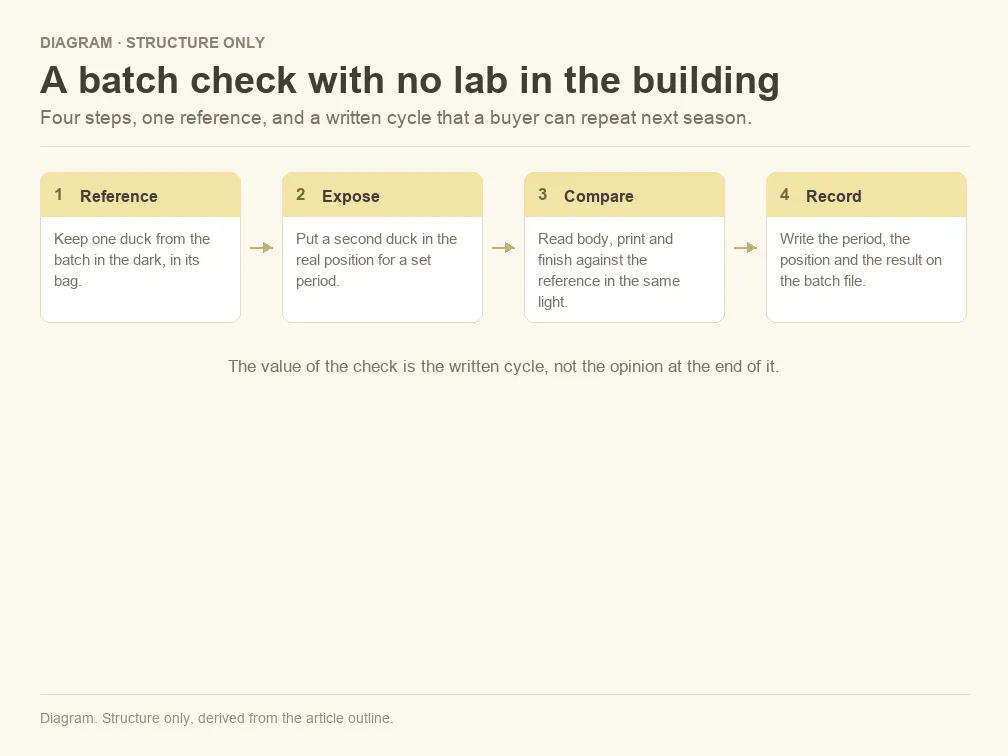
A buyer without a weathering chamber can still run a check that means something, as long as the check is written down and repeated. The method is a reference duck kept in the dark, a second duck placed in the real position, and a comparison made in the same light at a stated interval.
The comparison has to be made layer by layer. Look at the body colour away from the print, then at the edge of the mark, then at the reflection on the head. A result that says the duck looks faded is not a result, and a result that says the mark edge dulled after a stated period in a stated position is one.
The batch file then carries the period, the position, the light and the outcome. That file is what makes a claim possible next season, because it lets a buyer compare a new batch with a known one instead of comparing a duck with a memory. The consistency note covers the same discipline applied to a production run.
Five questions that settle the dash spec
- Which layer is allowed to change first, and how much change is acceptable on the body, the print and the finish?
- Which compound line and which stabiliser package are on the sheet, and who checked them?
- Which weathering test was run, at what irradiance and temperature, and can the report be read?
- Where will the duck sit, and does the programme instruct members to rotate or store it?
- What will the batch file record, so the next season can be compared with this one?
Five answers fit on one page, and that page is worth more than a longer one that leaves the layers unnamed. The questions also force the buyer and the supplier to talk about the same duck, which is the part that usually goes wrong when a fade complaint arrives.
Final Note
My preference is to specify the compound and the print separately, then choose the plainest finish that the design can live with. That combination gives the longest life on a dashboard and the simplest conversation when something does change, because each layer has its own line and its own test.
A faded dash duck is not a scandal. It is a duck doing what its specification allowed, in a place that asks more of it than a shelf ever will. The programme that wins is the one that decided which change was acceptable before the batch was moulded, and wrote it down.
Frequently Asked Questions
Which Jeep duck colours fade fastest on a dashboard?
Pale and bright tints usually show a shift sooner than a deep, saturated colour, because the eye reads a small change in a light tone more easily. The honest answer is that the pigment class matters more than the colour name, which is why the compound line belongs on the sheet.
Is a faded dashboard duck a defect?
Not by itself. A defect is a result outside the agreed specification, so a duck that changed within the range the buyer accepted was not defective. The defect question only has an answer when the range and the test were written down before the batch.
What specs should a dash-duty duck carry?
Four lines: the compound family, the pigment class, the stabiliser package and the weathering test that was run. Add the print method and the finish, and the sheet describes every layer that will age. Anything shorter is a label rather than a specification.
How should a club explain fade to recipients?
As a normal result of the place the duck lives, with the practical fixes attached: rotate it, shade it, store it between seasons. A club that says the duck may change in the sun and explains why is more credible than one that promises it will not, and it avoids a complaint that cannot be answered.
Key takeaways
- Why a dashboard is the hardest place a duck lives: light, heat and time arrive together, and only one of them is visible.
- What fades first, and in what order: the body outlives the print, and the print outlives the shine.
- Light and heat are two stressors, not one: the dose starts the change and the heat sets the rate.
- Colour lives in the compound: pigment and stabiliser are decided before moulding, not after.
- The UV package and the line that specifies it: a named stabiliser and a named test, or the label means nothing.