A new hire welcome kit is judged by what is still on the desk after the first month, and that test is harsher than it sounds. Most welcome kits are designed as a gesture and then measured by nothing at all, which is why so many contain a tote bag, a notebook, a sticker sheet and a duck, and why the duck is the item still visible in the second week.
In short: a duck earns its place in an onboarding kit when it is small enough to sit on a desk, carries one clear mark, and arrives inside a kit that names the company rather than describing it. The kit fails when the duck is a giveaway rather than a welcome, when the mark is a logo dump, and when every cohort receives a different object because nobody wrote the specification down.
What a welcome box is actually for
A welcome box has one job in the first week: it gives a new hire something to put down. The first days are full of screens, forms and names, and a physical object on the desk is a small anchor. That is the job. It is not to impress a candidate, and it is not to replace a conversation about values.
Once the job is stated that way, the contents sort themselves. Items that sit on a desk and get used are kept: a duck, a notebook, a decent pen, a card. Items that need a decision before they can be used are stored: a shirt in the wrong size, a bag that is too formal for the office, a gadget that needs an account. Items that are only a logo are thrown away, usually within a day.
The duck has an unusual advantage in that sorting. It needs no size, no account and no decision. It sits where it is put, it survives being moved, and it is cheerful without being childish when the mark is handled well. That is also its risk: a duck with a bad mark is a duck that goes home in a bag, and a kit that goes home in a bag is a kit nobody remembers.
The five layers of a kit that gets kept
A kit that gets kept tends to have five layers, and each one does a different job. The box, the card, the object, the mark and the story. Remove one and the kit still works, but it stops being memorable.
The box is the first layer, and it only has to survive a courier and open cleanly. A box that is hard to open is a bad first impression, and a box that is too large for its contents is a waste that the new hire notices. The card is the second layer, and it is the layer that carries the message: a name, a sentence, a signature. A card carries more meaning than any object in the box and it is the part people keep longest.
The object is the third layer, and it should be the thing the kit is remembered by. The mark is the fourth, and it belongs on the object rather than on everything. The story is the fifth, and it is usually missing: a line explaining why the company gives a duck, or what the duck has to do with the work. A story turns an object into a habit, and a habit is what keeps the duck on the desk after the novelty has gone.
Choosing the duck for a new hire
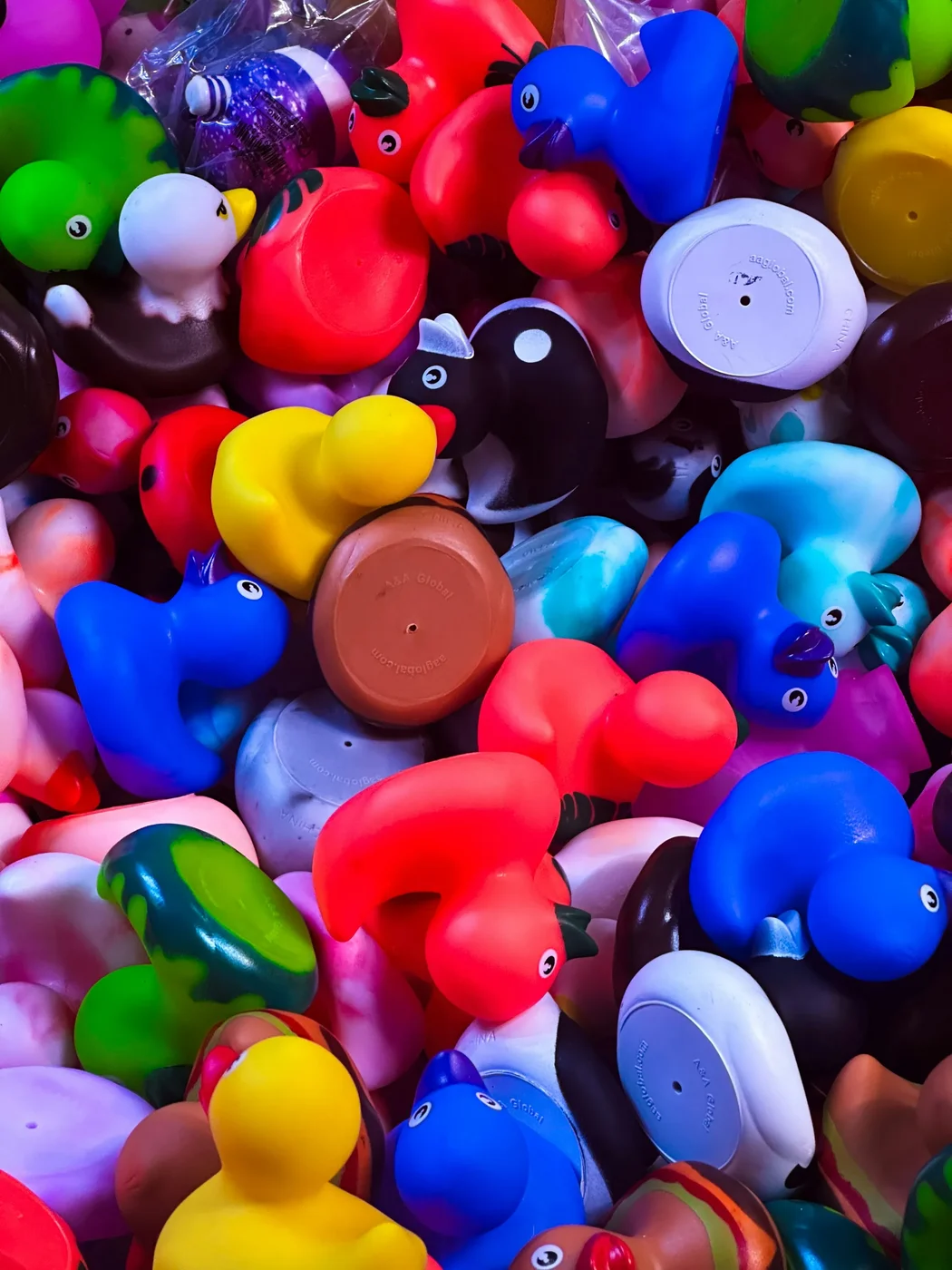
The duck decision has three variables and only one of them is about taste: size, mark and body. Size decides whether the duck fits the kit and the desk. Mark decides whether it reads as the company or as a generic toy. Body decides whether it survives being handled by people who are not careful with it.
Size is the most practical. A duck that is too large takes the whole box and becomes the kit. A duck that is too small disappears in a drawer. The middle of the range sits on a monitor stand, a desk corner or a shelf without competing for space. The size chart notes give the dimensions rather than an impression.
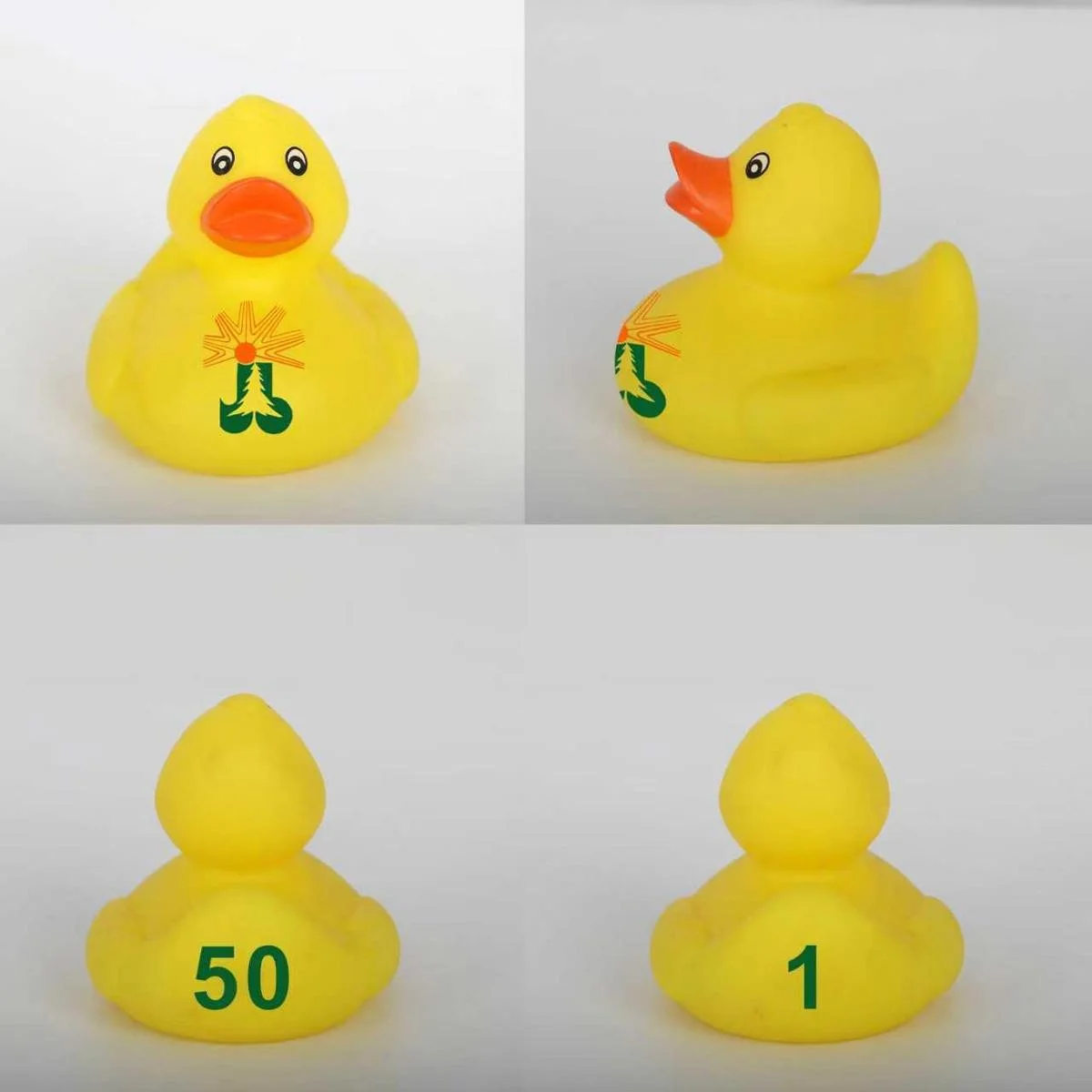
The mark is where most corporate ducks go wrong. A new hire duck does not need the full logo suite. It needs one mark that reads at arm's length plus one line of text at most. A mascot works better than a logo when the company has one, because a mascot is a character and a logo is a signature. When there is no mascot, a single strong wordmark on one surface reads better than four small marks on four surfaces.
The body is a durability question rather than a design one. A desk duck is handled, dropped and occasionally squeezed by a visitor's child. A one piece moulded body with no attached parts is the version that survives that life without creating a small parts question. The design revision notes explain how to lock the design so that a later cohort does not get a slightly different duck.
Proof, print and the batch behind the kit
An onboarding kit is a small order with a long life, because the same object is handed out for years. That changes the print decision: the mark has to be repeatable across cohorts, which means the file, the colour and the surface have to be specified rather than remembered.
A proof is the document that makes repetition possible. It shows the mark at final size on the final body, and it is what a second order is compared against. Without a proof, the second cohort gets a duck that looks the same to the person who ordered it and different to the new hire who compares it with a colleague's duck from last year. The logo fading notes describe the retained unit that makes that comparison possible.
The batch decision follows. A kit programme usually runs one small order per cohort or one larger order per year. The small order is more flexible and harder to keep consistent. The larger order is consistent and creates a storage question. Neither is wrong, and the choice should be made with the storage answer already in hand, which is the argument in the storage and shelf life notes.
The first week ritual that earns the duck a place
A duck on a desk is a habit, and habits are built by a moment. Companies that get this right usually attach the duck to a moment in the first week: it is on the desk when the new hire arrives, or it is handed over at the end of the first day, or it is placed by a manager during the first one to one.
The moment matters more than the object. A duck left in a box is a duck that gets taken home and forgotten. A duck placed on the desk by a person is a duck that stays, because the new hire watched it arrive. That is the whole ritual, and it takes ten seconds.
The second ritual is the name. A duck with the new hire's name on it, or on the card beside it, stops being company merchandise and becomes a personal object. Personal objects stay on desks. The artist and file notes matter here, because a name is a variable and a variable in print has to be planned rather than improvised.

Repeat hires: making the duck a standing item
The second cohort is where a kit programme either becomes a process or falls apart. The first kit was designed by someone with time and enthusiasm. The second kit is ordered by someone else, from memory, with a different supplier and a slightly different duck.
The fix is a single page of specification that survives staff changes. It should name the duck, the body colour, the mark, the print method, the pack and the retained reference. That page is the difference between a programme and a series of one off purchases, and it is also what makes a reorder a reorder rather than a new project.
The specification has a second use: it makes the kit reviewable. A new HR lead can look at the page, look at the duck on a colleague's desk, and see whether the programme is still doing what it was designed to do. The supplier request notes show how those lines are written in a way a supplier can act on.
The safety question a corporate duck still has to answer
A corporate duck is a toy, whether or not anybody calls it one. It goes home, it sits on a desk, and it is handled by children who visit an office or live in the same house. That means the toy obligations do not disappear because the buyer is an HR department.
The first question is what the duck is made of and whether it is safe in the hands of the people who will actually hold it. The CPSC toy safety guidance sets out the obligations that follow a product intended for children, and the practical version for a corporate buyer is to ask which standard the duck was assessed against and to keep the report with the order file.
The second question is the label. A toy carries information about its age suitability and, where relevant, a warning about small parts. 16 CFR 1500.19 is where the small parts warning requirements sit for toys. A one piece duck with no attached parts is the simplest object to place in a kit that will be taken home, and the toy safety label notes describe the marks that have to be visible.

A kit checklist before the first cohort arrives
The checklist below is deliberately short. Every line on it is a decision that is hard to change after the first order, and easy to settle before it.
| Line | What it fixes | What breaks without it |
|---|---|---|
| Duck and size | Whether the kit fits and the desk accepts it | A kit that is all box, or a duck lost in a drawer |
| Mark and placement | How the company reads on the object | A logo dump, or a mark that needs a close up |
| Body and parts | Whether the duck survives handling | An attached piece that raises a small parts question |
| Pack | How the kit opens and travels | A box that fights the new hire on day one |
| Retained reference | Whether cohort two matches cohort one | Two ducks that look different in a photograph |
| Safety file | What can be claimed and shown | A claim nobody can back with a document |
The line most often missing is the retained reference, and it is the one that decides whether the programme looks deliberate in year three.
Where this page stops
This page covers the kit, the duck choice, the print repetition and the safety question. It is not the page for the print method, the material specification or the event giveaway, and those pages exist. The print side belongs to the UV and pad comparison, the material side to the PVC and TPR comparison, and the event side to the conference bag notes.
What is left here is the first week. A kit that arrives before the new hire, with a card that uses their name and a duck that has a place to sit, has done its job. Everything else in the box is an extra.
The questions I would settle before the first kit is ordered
- Where will this duck sit in the first week, and does it fit that space?
- What is the one mark it carries, and does it read without a close up?
- Does the duck have any attached part that changes the safety answer?
- Who stores the reference unit and the file for cohort two?
- Is the kit one order per cohort, or one order per year with storage?
I would not order a single duck until the first and fourth questions have answers, because one decides whether the object is usable and the other decides whether the programme is repeatable. The middle three are the difference between a nice gesture and a kit that looks deliberate.
Frequently Asked Questions
What size duck fits a new hire welcome box?
Small enough that the duck does not become the whole box, and large enough that it is visible on a desk. The middle of the range is usually right for a welcome kit, because it fits beside a monitor or on a shelf without competing for space. The dimensions matter more than the impression, so start from the box internal size.
Should the duck carry the company logo or a mascot?
A mascot reads better when the company has one, because a character is remembered as a character. A logo works when it is used as a single mark on one surface rather than repeated across the body. The test is whether the mark reads at arm's length in a photograph, which is how most colleagues will first see it.
Do we need a custom mould for an onboarding duck?
Usually not. A stock body with a printed mark covers most onboarding programmes and keeps the first order small. A custom mould makes sense when the shape itself carries meaning, such as a mascot that is not a duck, and it changes the order from a print job into a tooling project.
How do we keep kits consistent across cohorts?
Write one page that names the duck, the body colour, the mark, the print method, the pack and the retained reference, and keep the approved unit with the file. A second order is then compared against an object rather than a memory. Without that page, consistency depends on whoever happens to place the order.
Final Note
A welcome kit is a small piece of the first week, and the first week is where a new hire decides what kind of place they have joined. The duck cannot carry that decision on its own. It can be the object that makes the desk feel occupied, and that is enough.
I would rather see one duck on one desk in month three than a box of branded items in a cupboard. The kit that gets kept is the kit that was designed for the desk rather than for the photograph of the kit.
Key takeaways
- A welcome kit is judged in the first week, on a desk, not in the unboxing.
- The duck wins because it needs no size, no account and no decision.
- Five layers: box, card, object, mark and a story worth repeating.
- One mark that reads at arm's length beats four small logos.
- A one piece body avoids the small parts question on the desk and at home.
- A retained reference unit is what makes cohort two match cohort one.
- Attach the duck to a moment in the first week and it stays.
- Write the specification down or the programme becomes a series of one offs.