Jeep duck orders are specifications rather than numbers, because the number is the part everyone agrees on and the part that rarely causes trouble. What causes trouble is everything else the order contains: the body, the colour, the tag, the card, the pack and the file. A club that settles those six things gets a run that behaves. A club that only settles the count gets a carton of ducks nobody can use the way they planned.
Written as a working note on club orders, with public toy safety guidance cited where a rule applies.
In short: A wholesale Jeep duck order holds six things: the body, the colour, the tag or card, the pack, the count, and the compliance file. The count is the least interesting of the six. The order works when each of the other five is written down before the run, because each one is decided in production and cannot be fixed afterwards without a new run.
The order is a spec, not a figure
A figure is a quantity. A spec is a set of decisions that a factory can build to. The difference shows up on delivery: a club that ordered a figure has to inspect whatever arrives and hope it fits the plan, while a club that ordered a spec can compare the cartons against what it wrote down.
The spec does not have to be long. One page with a line per decision is enough, and the same page becomes the reference for the next run. The order-terms note covers what sits on the money side of the same document.
What the order actually contains
| Line | What it locks | Who checks it |
|---|---|---|
| Body | Size, base, beak and eye detail | The club approves the drawing |
| Colour | The club colour, held to a reference | The club signs a physical swatch |
| Tag or card | The message, the size and the attachment | The club approves the copy before print |
| Pack | Bag, header card, polybag or box | The club states where the duck will be handed out |
| Count | The number and how it divides into inner packs | The club counts from members, not from a guess |
| File | The safety record that covers the run | The club asks before the first carton |
One body, a club colour, a tag
Most clubs need one body. A duck is handed out, tagged and hidden, and the body does not need to change between seasons. What changes is the colour and the tag, and both are simpler to change than a mould.
The colour is the part that drifts. A club colour that looks right on a phone screen and wrong in a photograph is a colour that was never signed on a physical reference. Ask for a swatch, keep it, and compare the next run against it. The colour note explains how a colour is held across a run, and the material note covers the feel difference that matters when a duck is handled constantly.

The card that explains the game
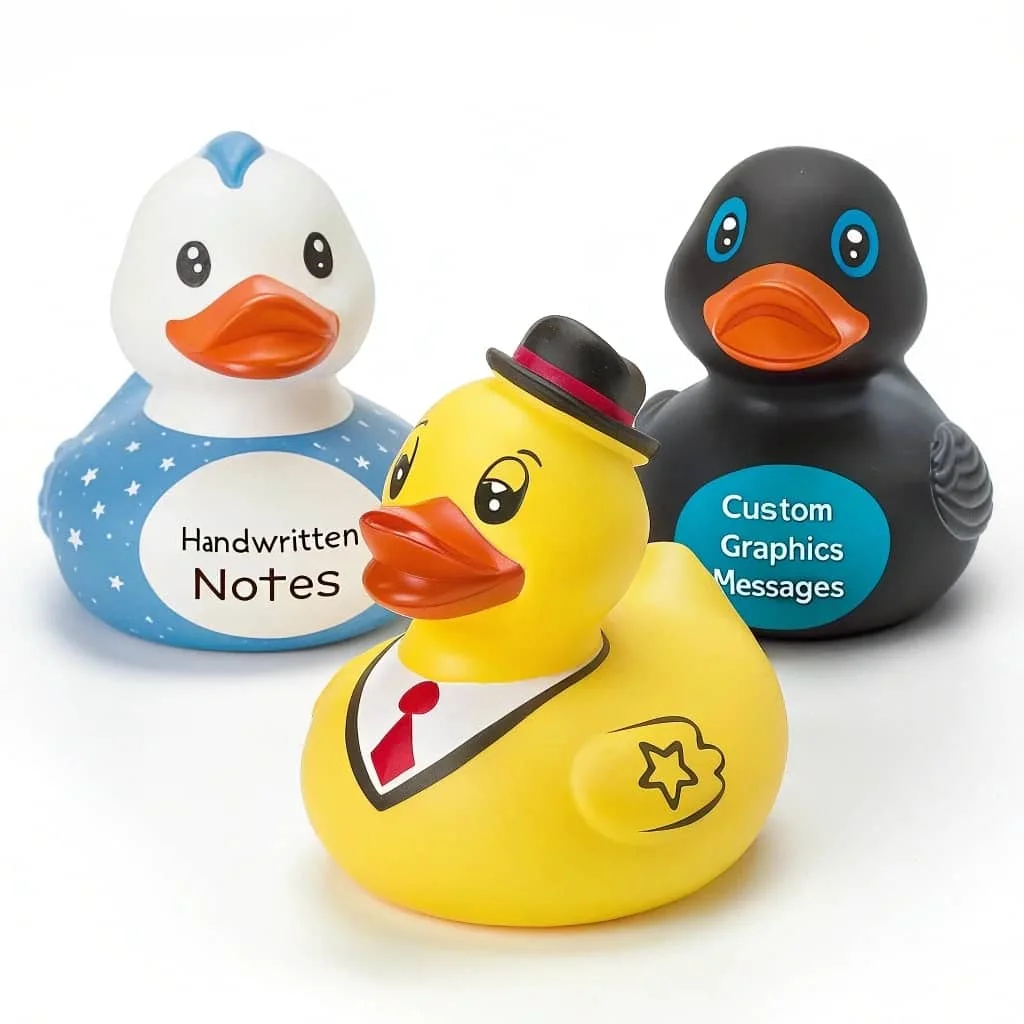
The card is what turns a duck into part of the game. A new finder needs to know what the object is, what to do with it and where to say so. That is three short lines, and a card the size of a business card holds them comfortably.
Two details decide whether the card works. The first is the size of the text at arm's length, because a card read in a parking lot is read quickly. The second is whether it survives a car, which usually means a sleeve or a laminated finish. The tag format note compares the options, and the packaging note covers the sleeve.
Counts that survive a club season
A club count is not a member list. It is the number of ducks the club expects to place across a season, plus a buffer for events, new members and the ducks that go missing from a bag. The number is usually higher than the member count and lower than the first guess.
Then the count meets the inner pack. If the factory packs in fixed inner packs, an awkward total becomes a partial box, and a partial box is a packing conversation. Counting to a round inner pack is simpler and more robust than counting to an exact head count. The carton note explains how the division works.
The pack line on a Jeep order
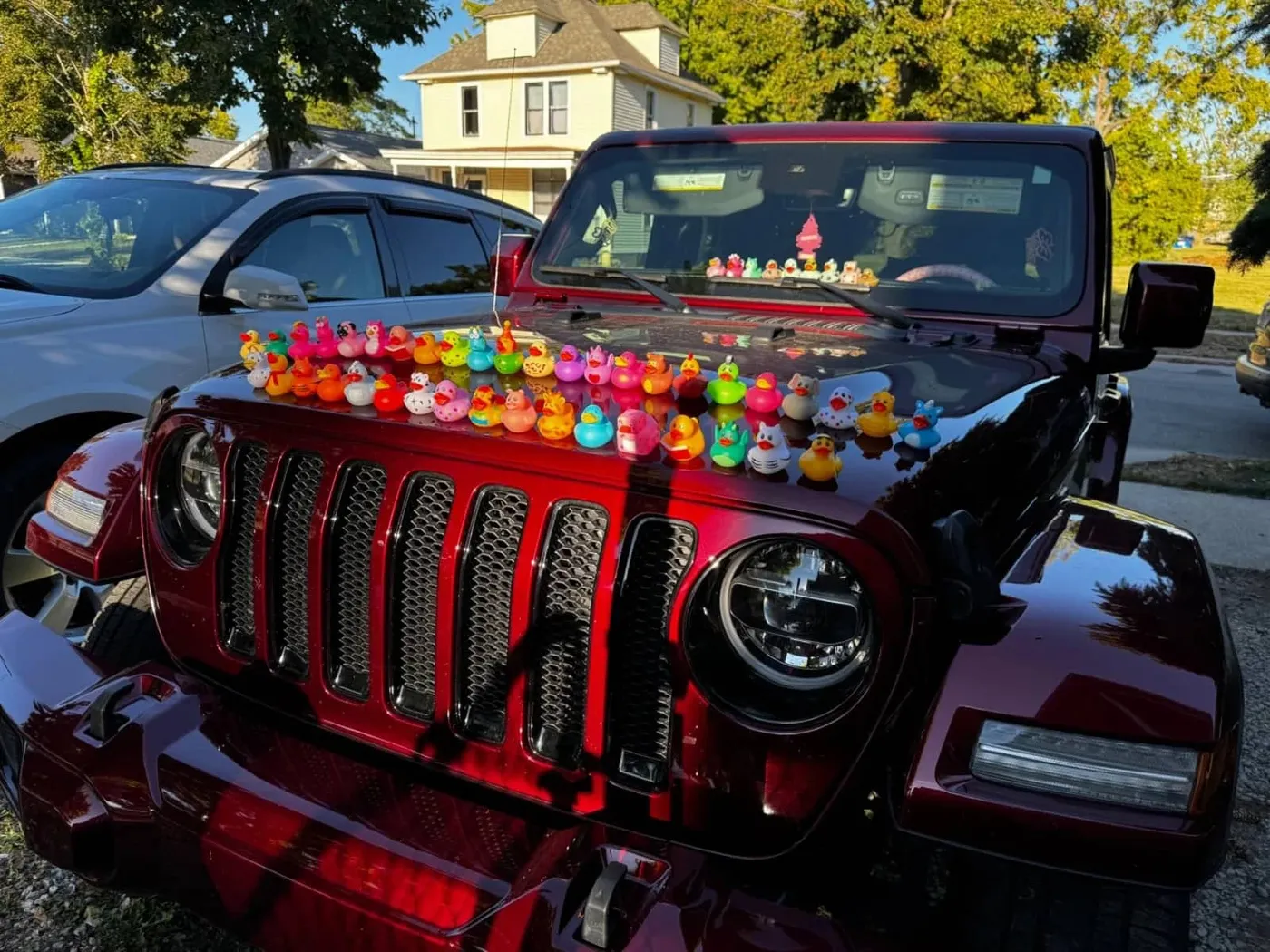
A club duck is usually handed out loose, in a bag or with a card. Each of those is a pack decision, and each one changes the feel of the run and the look of the handover. A duck in a plain polybag with a card inside looks like a gift. A duck in a printed header bag looks like merchandise. The same duck, two very different gestures.
The pack decision should follow the moment of handover. If the duck is left on a vehicle, the card has to survive weather. If it is handed to a member, the bag matters more than the card. The pack note covers the jobs a pack has to do, and the set note covers how a club set is assembled.

The file behind a community order
A duck left on a vehicle will be picked up by whoever finds it, and that can include a child. The CPSC's toy safety guidance sets out the testing and certification duties that apply to a children's product, and a community giveaway is not exempt because it was free.
The small parts rule is the practical one for this category, because a club duck often carries a small accessory. Under 16 CFR 1501.4, a toy for a child under three must not be small enough to fit entirely inside the Commission's test cylinder, and a detached piece is tested the same way. A club that orders one body and one tag keeps the file simple; a club that adds a charm to every duck adds a question to it.
What to write down before the first carton
Six lines, in this order: the body and its size, the club colour against a reference, the card copy and its attachment, the pack and the handover moment, the count against the inner pack, and the safety file. A club that writes those six lines once has a template for every season after.
The template is also the answer to the question every new club officer asks: what do we order? The answer is not a number. It is the page.

- Does the club have a colour reference, or only a screen colour?
- Which moment does the pack have to survive: a vehicle, a hand or a bag?
- Is the count built to the inner pack?
- Has anyone asked what the run's safety file covers?
Frequently Asked Questions
Does a wholesale order beat buying from a reseller?
It usually is per duck, because the order skips the reseller's margin and the retail pack. The trade is that the club takes on the decisions a reseller would have made: the body, the colour, the card and the file. Those decisions take time, and a club that leaves them open pays for them in delays rather than in money.
How many ducks should a first wholesale order hold?
Enough for a season plus a buffer, counted to a round inner pack. A club that orders exactly the member count runs out at the first event, and a club that orders a year of stock at once holds cartons it may not need. One season is the usual starting point.
Should the ducks be stock or custom?
Custom for the body colour and the card, stock for the body shape if the club is new. That combination keeps the tooling simple and the club identity visible, and it can move to a custom body once the club knows what its members actually use.
What goes on the header card?
Three short lines: what the duck is for, what the finder should do, and where to share it. A card that carries a paragraph will not be read in a parking lot, and a card with no action on it turns the duck into a souvenir rather than part of the game.
Final Note
A club order with one page of decisions and one body beats a large number with nothing written behind it. The duck is the easy part of a Jeep order. The colour, the card, the pack and the file are the parts that decide whether the run lands the way the club imagined, and they are all settled before the first carton is packed.
Key takeaways
- The order is a spec, not a figure: a quantity is not a specification.
- What the order actually contains: six lines, from body to file.
- The card that explains the game: three short lines, readable at arm's length.
- Counts that survive a club season: build the count to the inner pack.
- The file behind a community order: a giveaway to a child is still a children's product.